


Every Kilimanjaro operator's website has a table like this: Marangu 50%, Machame 85%, Lemosho 90%, Northern Circuit 95%, and so on down the list. I went looking for where those exact numbers come from before writing this, because, if you're planning a trip this size, you deserve a straight answer rather than a tidy-looking table nobody can trace back to a source. What I found is that the precise percentages almost everyone quotes, ours included, don't hold up to that kind of scrutiny. What does hold up is the underlying reason those numbers point the way they do: more days on the mountain, taken at the right pace, really raise your odds. That's the honest version of this article, and it's still a confident one.
Where the "90% on Lemosho" number actually comes from
I spent a few days chasing the origin of the per-route success rate tables that show up on nearly every Kilimanjaro operator's site, ours included until now. There's really only one real dataset behind almost all of them: a set of figures attributed to the Kilimanjaro National Park Authority (KINAPA) from 2006, which reported an overall summit success rate of 45% across all routes, and a breakdown by number of days on the mountain rather than by named route: roughly 27% for 5-day itineraries, 44% for 6-day, 64% for 7-day, and 85% for 8-day. There was no 9-day figure, because 9-day itineraries like the Northern Circuit didn't exist yet; that route wasn't introduced until 2014.
Two things are worth knowing about that data. First, it's now roughly twenty years old and, as far as I can find, has never been updated or re-published by the park authority itself. Second, even the most detailed public success-rate breakdowns you'll find online, including from other well-established Kilimanjaro operators, openly label their per-route numbers (Lemosho at 90%, Northern Circuit in the 85-95% range, and so on) as estimates built on top of that old baseline, not measurements. One large operator's own published breakdown says plainly that its figures for specific routes are "estimated" from combining the 2006 data with the operator's own guess at how the industry has shifted since. That's a reasonable guess. It isn't independent data, and I don't think it's fair to print it as if it were.
So here's the honest position: there's no single reliable public dataset that breaks Kilimanjaro summit success down cleanly by exact route, at least not one I could independently verify. What we do have is decent evidence, some of it from actual peer-reviewed research, that the itinerary length and ascent profile matter enormously. That's a real answer, just a less tidy-looking one than a table with a percentage next to every route name.
{{leadmagnet-one}}
What "success" even means, and why that muddies the numbers further
There's another wrinkle worth knowing about, because it makes me trust these percentages even less. Kilimanjaro National Park issues certificates at three separate points: Gilman's Point (the rim), Stella Point (higher up, on the crater rim near the glaciers), and Uhuru Peak, the true summit. All three get you a certificate. Nobody publishes a clear definition of which of those counted as "success" in the 2006 data, and different operators define it differently today. When we talk about our own numbers internally, we mean climbers who reached Uhuru Peak specifically, the actual top, not the rim. If another operator is counting Gilman's Point climbers in their "success rate," their number and ours aren't measuring the same thing even before you get to the question of whether either number is independently audited. That's one more reason I'd rather tell you what actually drives the outcome than hand you a number I can't fully stand behind.
What the peer-reviewed research actually says
There is real science here, and it's more specific and more useful than any marketing table, even if it doesn't map neatly onto route names.
The most frequently cited study is Davies et al., published in Wilderness & Environmental Medicine in 2009. Researchers stationed themselves at three huts on the Marangu route (2,700m, 3,700m, and 4,700m) for sixteen days and measured heart rate, oxygen saturation, and Lake Louise Score (the standard clinical scale for acute mountain sickness) in 312 trekkers each night of their climb. Of the 181 climbers with complete data, 111, or 61%, reached the summit, and 139, or 77%, developed some degree of AMS. One finding surprised me: the study compared climbers doing Marangu over 4 days versus 5 days, and found AMS incidence and summit success were similar between the two groups. In other words, on that specific route, one extra day on an already fast, fixed itinerary didn't move the numbers much. What did predict failure clearly was symptom severity: climbers who scored 5 or higher on the Lake Louise Score at any point on the mountain were far more likely to turn back.
A second study, Lawrence and Reid, published in the same journal in 2016, followed climbers on a 6-day ascent (via the Rongai route, through a single tour operator) between 2012 and 2014. It found that age 40 and over, and female sex, were both significant predictors of an unsuccessful summit attempt, alongside the same pattern Davies found: a high Lake Louise Score at any stage strongly predicted not reaching the top.
In plain terms, a Lake Louise Score is a short self-assessed checklist (headache, nausea, fatigue, dizziness, disturbed sleep) that clinicians use to score how bad your AMS symptoms are on a given day. A score of 5 or higher is the point at which both studies found people were significantly more likely to fail to summit, which is a useful thing to know for yourself on the mountain: a mild headache on day two isn't a reason to panic, but a cluster of worsening symptoms is exactly the signal your guide is trained to act on.
I want to be straight about what these studies do and don't tell us. Neither one compares Lemosho against Northern Circuit against Machame head to head. Davies is specific to Marangu; Lawrence and Reid is specific to a 6-day itinerary on one route through one operator. Nobody has run the kind of large, independent, route-by-route trial that would let anyone state "Lemosho is 90%, Northern Circuit is 95%" with real confidence. What both studies do confirm, and this is the part that actually matters for planning your climb, is that ascent rate and AMS symptoms are the mechanism driving success or failure, far more than which named trail you're technically walking on. A route that happens to spread the same altitude gain over more days, with more nights to sleep at a lower elevation than you climbed to that day, gives your body more chances to adjust before it's asked to perform at 5,895m.
Why we still point people toward 8 days or more
This is where Chris's two decades on the mountain, and something like 300 summits led, matters more than any table. His view has always been the same one the research backs up: the single biggest thing you control is how much time you give your body to adjust, not which route logo is on the itinerary. (You can meet Chris in a great short video here)
The mechanism is "climb high, sleep low": spending the day at a higher altitude than you sleep at, so your body starts producing more red blood cells and adjusting to lower oxygen before you're asked to sleep there permanently. Routes and itineraries that build in more of these acclimatisation days simply give you more chances at that adjustment before summit night. That's true regardless of the route's name. It's why a 6-day Marangu itinerary and an 8-day Lemosho itinerary aren't really comparable trips wearing different labels; one gives your body roughly two-thirds the adjustment time of the other, on top of Marangu's own fast, hut-to-hut ascent profile.
This is also why at Follow Alice our top recommendations are the 8-day Lemosho route and the 9-day Northern Circuit. Not because either one carries a magic verified percentage, but because both build in the extra days and the gentler daily altitude gain that the research above says actually drives outcomes. If you want the mechanics of that acclimatisation profile route by route, our route ranking by acclimatisation and our general guide to acclimatising well go into more detail than I can fit here.
Lemosho and Northern Circuit, compared
Both routes give you more days than the industry average, but they're not identical trips, and the honest answer to "which one" depends on what you want out of the week, not on a percentage.
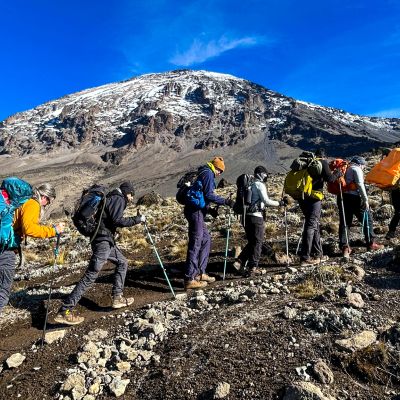
The 8-day Lemosho route starts on the mountain's quieter western side, crosses the Shira Plateau, and joins the southern circuit below the Lava Tower before tackling the Barranco Wall, a scramble that's more fun than it sounds and one of the most photographed moments on the mountain. It gives you five full nights above 3,000m before summit night, and it's become the itinerary we default to for climbers who want strong acclimatisation without adding a full extra day.
The 9-day Northern Circuit is the longest way around the mountain and the newest named route, only introduced in 2014. This is Chris’s favourite route on the mountain. It swings around Kilimanjaro's rarely visited northern slopes before joining the same summit approach, which means an extra day of gradual altitude exposure and noticeably quieter trails; you'll see far fewer other climbers on the northern side than on Lemosho or Machame. If your priority is giving yourself the most acclimatisation time available on the mountain, or you'd rather trade a busier trail for a quieter one, that extra day is the whole case for it.
The 7-day Machame route is worth mentioning here too, because it is consitently popular and, at 7 days, sits in a reasonable middle ground: more acclimatisation time than Marangu, less than Lemosho or Northern Circuit. It's a legitimate choice if a week is what you have. I just wouldn't tell you it carries some precise, verified success percentage that Lemosho doesn't; the honest version is that it gives you meaningfully less buffer than the two longer options, and meaningfully more than Marangu. If you have previous experience at high altitude and a strong level of fitness the 7-Day Machame or Lemosho could be a good fit.
{{leadmagnet-one}}
Where Marangu and shorter itineraries fit
I don't think shorter routes deserve to be written off, but they deserve an honest framing. Marangu, sometimes called the "Coca-Cola route" because of its hut accommodation and gentler-looking terrain, is usually done in 5 or 6 days, which is the fastest ascent profile on the mountain. That speed is exactly what the Davies study measured, and it's exactly why AMS incidence in that research was so high (77%) and summit success comparatively low (61%), even with the huts and gentle gradient. If you're really short on time or budget, it's a real option; just go in knowing you're choosing speed over acclimatisation buffer, and that the symptoms the research flags (headache, nausea, disturbed sleep, a Lake Louise Score climbing over the trip) are worth taking seriously and telling your guide about immediately rather than pushing through. Our guide to altitude sickness on Kilimanjaro covers what those symptoms actually feel like and what to do about them.
What actually happens on the mountain
None of the research above changes the fact that a lot of what determines your specific outcome happens day to day, on the trail, with the people around you. This is the part that we and Chris care most about, and it's also the part that's easiest to check independently, because it shows up in what our past climbers have actually said.
Our guides run daily health checks and watch for AMS symptoms directly, which is the same mechanism the Davies and Lawrence-Reid studies flagged as the real predictor of success. One Trustpilot reviewer described lead guide Robert and his assistant guides staying with a climber who was struggling and feeling unwell, and getting them to the summit anyway through steady encouragement rather than pushing them past what was safe. Another climber, on an 8-day Lemosho trip, credited guide "Robert (or Bobu) and the entire crew" with keeping the group's morale up to the point where all ten members summited together. A 64-year-old climber on a different trip wrote that guide Florence "coached and encouraged me from Stella Point to Uhuru Peak," the final, hardest stretch of the whole climb. And on the Northern Circuit specifically, one reviewer's entire account was simply that the nine-day expedition "was excellently handled" and that "everything was taken care of."
That kind of support starts well before you reach Tanzania. My brilliant colleague Meera, who coordinates trip planning, is often mentioned by name in more than one review as being "very responsive" and answering "every email" during the run-up to a climb. And our crews are KPAP-certified, meaning porter loads, pay, and conditions are checked against the Kilimanjaro Porters Assistance Project's independent standards, not just our own word for it.
None of that replaces acclimatisation days. It's what happens inside them.
The other piece climbers ask me about less than they should is fitness. Neither Davies nor Lawrence and Reid found that being an athlete predicted summit success the way age and AMS symptom severity did, and that matches what Chris has seen leading climbers up the mountain for years: you don't need to be able to run a marathon, but you do need enough cardiovascular base that walking six to eight hours a day at altitude doesn't leave you too depleted to eat, sleep, and recover properly, which is its own quiet driver of AMS. If you want a specific plan rather than vague "get fit" advice, our guide to training for Kilimanjaro lays out what to actually do in the months before you fly out.
What I'd actually tell you
If I'm being direct: I'd take 8 days over 6, and I'd take 9 over 8 if your schedule and budget allow it, because the mechanism behind that advice is really well supported, even though the exact percentage I could put next to it isn't. Between Lemosho and Northern Circuit specifically, it's less about one being definitively better than the other and more about what you want that week to feel like: Lemosho's Barranco Wall and slightly shorter timeline, or the Northern Circuit's extra day and quieter trails. Either one gives your body a real chance to do what it needs to do before summit night. Between these two there is really no bad option, both will lead to best possible experience you can have on Kilimanjaro.
What I wouldn't do is pick a route because a table on some website says it has a 95% success rate. I don't think any operator, us included until now, can actually back that number up. What we can back up is why the extra days matter, and what we do differently while you're using them.
Ready to talk routes and timing?
Tell us your dates, your fitness level, and what you want out of the week, and we'll help you land on the itinerary that actually fits.
Book a call with our Kilimanjaro team