Misty, ancient and alive with wildlife, Nyungwe National Park is one of Africa’s oldest rainforests. From chimpanzees to rare monkeys and colourful birdlife, this remarkable forest feels wild, remote and unforgettable.
byTrisha Pillay
May 12, 2026
17 min read
Most travellers arriving in Rwanda have Volcanoes National Park fixed in their minds; it's all about the gorillas in the mist and the volcanic ridgeline. What many people don’t know is that the Nyungwe sits at the other end of the country and, for a long time, at the other end of most itineraries. This is slowly starting to change, and for good reason.
Nyungwe National Park is the largest tract of montane rainforest in Africa and one of the continent's oldest ecosystems. It's the kind of place where a single morning in the canopy can literally rearrange your sense of what a wildlife experience can be. This guide will cover everything you need to decide if Nyungwe belongs on your Rwanda trip, from the wildlife, the walking, the logistics, the best time to go, and what staying at the right lodge adds to the whole experience. If you have more questions, feel free to contact our team, and they will be happy to answer any of your concerns.
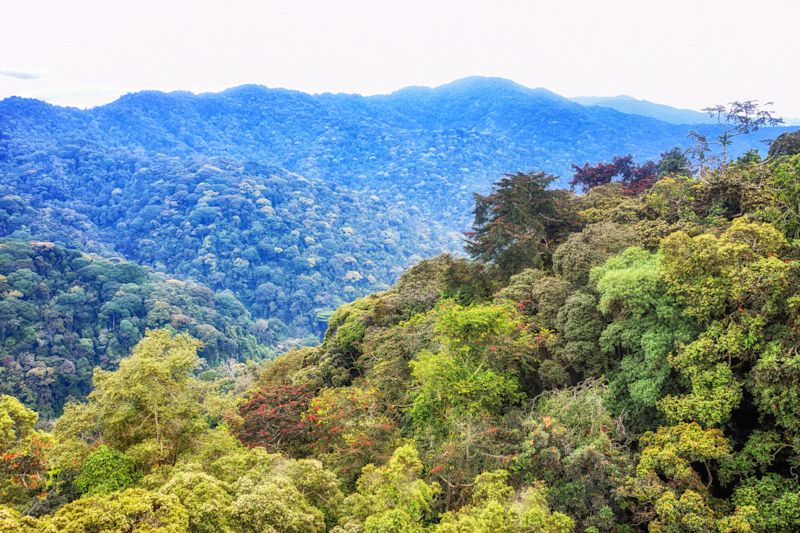
View from the canopy walkway of rainforest of Nyungwe National Park in Rwanda.
Nyungwe National Park covers 1,019 square kilometres (393 miles) of the Albertine Rift highlands in south-western Rwanda. The park feeds two of the world’s largest rivers, the Congo and the Nile, providing the country with a significant portion of its fresh water. This is an ancient forest, thought to be one of Africa’s oldest rainforests, and its layered complexity definitely shows its age. You will move from thick forest to bamboo slopes, then open heath, peat bogs, and high mountain grasslands. The landscape changes a lot in just one day’s walk, and that's what makes it one for the books.
This hydrological role partly explains why the park's conservation story matters beyond its boundaries. The biodiversity numbers are remarkable by any measure, with over 1,100 recorded plant species, 345 bird species, and 85 known mammal species. Thirteen primate species have been recorded in the park, which is more than anywhere else in Africa outside the Congo Basin, including chimpanzees, Ruwenzori black-and-white colobus, l'Hoest's monkeys, grey-cheeked mangabeys and olive baboons. The colobus troops, which can number several hundred individuals, are among the largest in Africa.
In 2023, Nyungwe was declared a UNESCO World Heritage Site, a recognition of its outstanding biological diversity and the ecological services it provides at a continental scale. The endemic species count across the Albertine Rift is higher here than in any other single forest in the range.
The conservation story behind Nyungwe National Park
Nyungwe was designated a Belgian forest reserve as far back as 1933, but it did not achieve national park status until 2005. This provided the park with the highest level of protection in Rwanda. The more recent development came in October 2020, when African Parks signed a 20-year management partnership with the Rwandan government. This followed their successful work in Akagera National Park, with over ten years of shared management, a once-degraded area was turned into a top safari destination in East Africa.
The changes for Nyungwe are important. African Parks takes a long-term, practical approach to managing protected areas by focusing on anti-poaching, working with local communities, tracking wildlife, and making sure the park can sustain itself over time and not just rely on tourism.
One example is the eco-ranger programme. Many rangers come from nearby communities, including some former poachers who have stopped illegal hunting and now help protect the forest. They remove snares and help monitor wildlife using their knowledge of the area. It’s not a perfect system, but it is a real and honest effort to improve things.
The community aspect is also taken seriously. Over 1,600 local people currently participate in sustainable economic activities through community cooperatives, benefitting more than 6,800 households. These cooperatives range from small-scale agriculture to handicrafts and tourism services. The logic is pretty straightforward because if a community benefits from a functioning forest, its people will have a reason to defend it.
For travellers wondering whether Nyungwe is worth the trip, African Parks’ involvement is a strong sign. It points to a park on an upward path with better trails, improved wildlife encounters, and more consistent conservation work.
African elephant foraging between yellow flowers at the Akagera National Park in Rwanda.
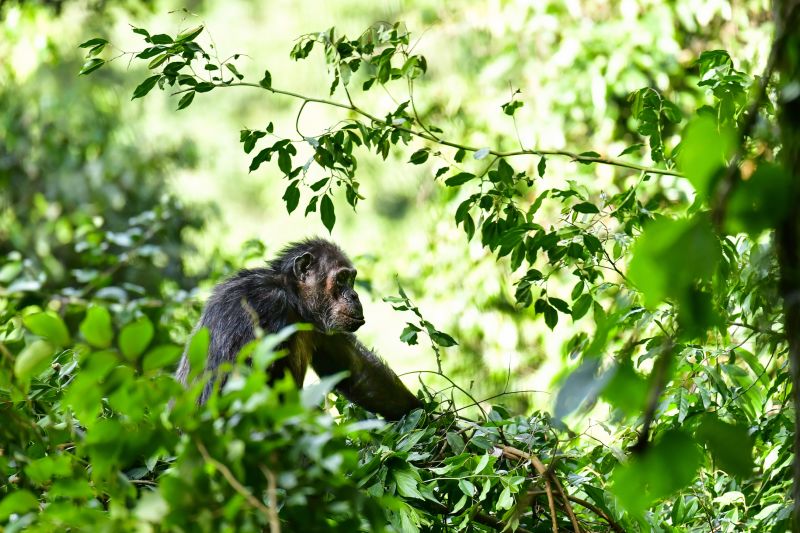
Chimpanzee trekking in Nyungwe is what most people come for, and it’s unlike anything else in East Africa. The forest is dense, and the terrain is steep. Unlike gorilla trekking in Volcanoes, where bamboo opens up, and sightings are often clearer, Nyungwe keeps you under a thick canopy. The light is green and filtered. The first sign of chimpanzees is usually loud, chaotic calls that reach you before you ever see them. When you do reach the group, the chimps are moving constantly, swinging overhead, crashing through branches, occasionally dropping to the ground with the kind of confidence that makes clear they are entirely unconcerned by your presence.
The habituation process for Nyungwe's chimpanzees has been ongoing for years, and the park currently has one fully habituated community used for standard trekking. Treks depart at 5:00 AM from the Uwinka or Cyamudongo tracking centres. The walk to find the chimps can take anywhere from 45 minutes to three hours, depending on where the community has ranged overnight. This is a forest where you earn the encounter; the terrain is humid, and the paths are often slippery, but the payoff, when you sit for your allocated hour with a habituated group, is among the most compelling wildlife experiences on the continent.
A note on the physical demands, though Nyungwe sits high, and the air is thinner than most visitors expect. The altitude, combined with the steep, uneven terrain, makes chimp trekking genuinely tiring. You do not need to be a serious hiker, but reasonable fitness is required, and sturdy boots are essential. The payoff for the effort is not just the chimps themselves; it is the forest, which at altitude feels primordial in a way that is difficult to articulate until you are standing inside it.
Chimpanzee trekking permits
The Rwanda Development Board issues permits, which must be booked in advance, particularly during peak season. Prices are set at USD 150 for international visitors, USD 75 for foreign residents of Rwanda, and USD 25 for Rwandan nationals. Booking through a reputable tour operator like Follow Alice is the most reliable approach as permits at busy periods sell out weeks ahead.
Chimpanzee just relaxing in its natural surroundings at the Nyungwe National Park in Rwanda.
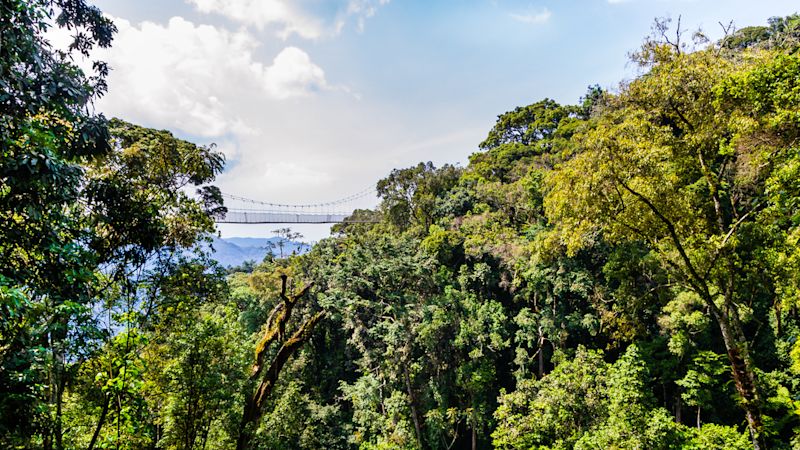
The canopy walk at Nyungwe is one of only a handful of its kind in Africa, and it earns its reputation. The walkway is suspended at up to 70 metres above the forest floor, stretching roughly 200 metres through the upper canopy with an observation platform at its midpoint. The experience divides neatly into two things: what it looks like and what it feels like.
It looks like an unbroken sea of forest canopy rolling to the horizon in every direction, a series of green ridgelines stretching away. On a clear morning, the view extends across the Congo-Nile divide and, on the best days, the distant peaks of the Virunga range are visible to the north. It is the kind of perspective that reframes the scale of what you are standing inside.
What it feels like is the walkway moving beneath you, not alarmingly, but enough to notice with every step, the suspension swaying slightly as you cross 70 metres above a forest floor that disappears completely beneath the canopy. For most visitors, this is exciting rather than frightening; for those with a genuine fear of heights, it is worth noting honestly that this is not for the faint-hearted. The walk takes roughly 30 to 45 minutes at a relaxed pace and is best done in the early morning, when the birds are active and the light angles low through the canopy.
Please note that the canopy walk can be combined with the adjacent Igishigishigi Trail, a roughly two-kilometre loop through primary forest that takes one to two hours and offers some of the best primate spotting in the park. Colobus monkeys are frequently seen along this route. The trail itself is free to walk, but the Canopy Walkway requires a separate paid permit.
Small boy walking along Nyungwe Forest National Park canopy walkway.
Nyungwe has 15 marked hiking trails ranging from short walks of under an hour to full-day treks of eight hours or more. This is, quietly, one of the most extensive walking networks of any forest park in Africa, and it is almost entirely unvisited relative to its quality. On most of these trails, you will encounter no other travellers.
The Isumo waterfall trail is the most popular day hike. It's a 10-kilometre round trip through primary rainforest that ends at a multi-tiered waterfall dropping into a gorge. The path passes through some of the park's oldest forest and is reliably good for birding on the way. The Bigugu Trail leads to the park's highest point at 2,950 metres and offers panoramic views across both the Congo and Nile watersheds on clear days. It's definitely a full-day commitment, but it's very rewarding. For those who want something shorter, the Uwinka Trail near the main visitor centre provides a two-hour loop with reliable colobus sightings.
All trails require a guide, booked through the park's visitor centre or your lodge. The guides at Nyungwe are knowledgeable, and the park's trail infrastructure has improved steadily since the African Parks partnership began. If you are staying for more than two nights, ask your guide which trails they recommend based on recent wildlife activity.
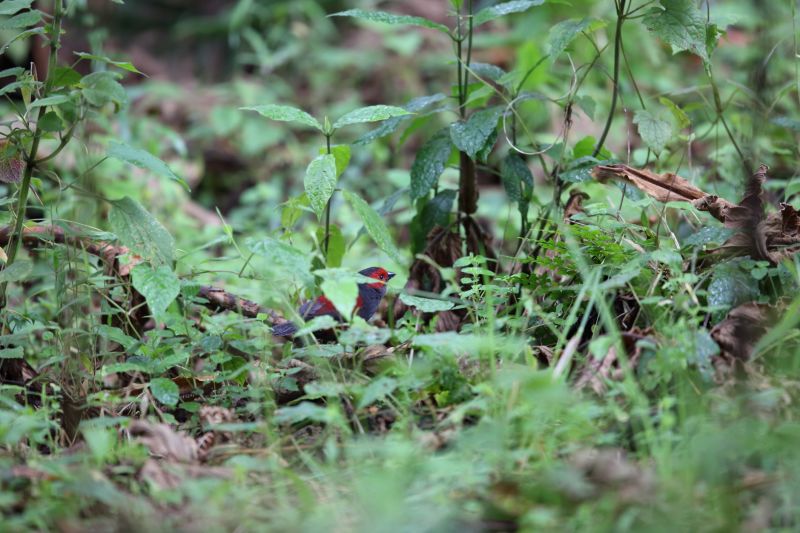
Dusky Crimsonwing (Cryptospiza jacksoni) in Nyungwe National Park.
The Nyungwe zipline
This is a forest that rewards flexibility, as it has so many things to like, such as the Nyungwe zipline, which spans 1,935 metres and is one of the longest in Africa. The experience is divided into three separate sections, namely 335m (1,099 ft), 580m (1,903 ft), and 1,020m (3,346 ft). You will be threading through the canopy at speed with views across the forest and tea plantations below. It is an entirely different way of moving through the landscape as it's fast, exposed, and kinetic. You can treat it as an adventure add-on or a genuine wildlife experience its totally up to you, but most visitors who do it find the perspective it offers to be unlike anything available on foot. You can book this through your lodge or the park visitor centre. If you have a travel operator, they would sort out those logistics for you.
The tea plantations you will see below you while ziplining.
Birding in Nyungwe
Nyungwe is one of the most important birding destinations in Africa. Of the 345 recorded species, 30 are Albertine Rift endemics, birds found nowhere else on earth. The park's altitudinal range means the species composition changes dramatically as you move up and down the slopes. Birders who come here specifically for the endemics often stay three to four nights and spend every usable morning in the forest.
The most productive hours are between 6:00 AM and 10:00 AM, before the temperature rises and bird activity drops off. The Isumo and Igishigishigi trails are consistently good for ground-level species; the canopy walk provides access to treetop species that are otherwise impossible to observe well from below. Notable targets include the Rwenzori turaco, the African green broadbill, the Grauer's swamp warbler and the strange weaver, which are all Albertine Rift endemics that Nyungwe holds in healthy numbers.
Even for travellers with a passing interest in birds rather than a dedicated list, Nyungwe is still one for the books. The dawn chorus in this high-altitude rainforest is unforgettable. Turacos move regularly through the canopy, and with almost no human noise around, the birdwatching feels peaceful, immersive, and remarkably wild. A dedicated birding morning with a specialist guide is worth adding to any Nyungwe itinerary.
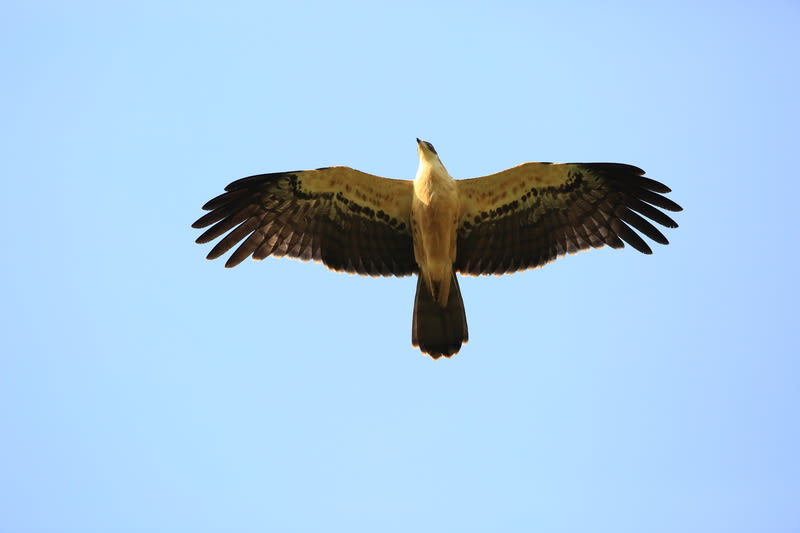
An Ayres's hawk-eagle in flight as seen from below in Nyungwe National Park in Rwanda.
The accommodation decision in Nyungwe is more consequential than in most parks, because the right choice genuinely changes the quality of the experience. One&Only Nyungwe House is described as one of the best serious luxury options in the area, and it sets itself apart from the moment you arrive. The lodge sits at the edge of the Gisakura Tea Plantation, one of the most photographed landscapes in Rwanda. You will see the rainforest rising directly behind it and the geometric patterns of the tea stretching out below.
The rooms and villas are designed around the forest views, with large windows and open terraces that keep you constantly connected to the landscape. It is the kind of place that makes it difficult to stay indoors. The food is excellent, with fresh produce from the lodge’s kitchen garden and nearby communities. There is also a spa, which feels especially welcome after a long chimp trek in the rain.
The lodge’s guides have strong knowledge of wildlife activity in the park, which can help shape your plans each day. Guests can also join a guided walk through the nearby tea estates, offering a different view of the landscape and a glimpse into Rwanda’s farming communities.
Mid-range visitors have the Nyungwe Top View Hill Hotel as a solid alternative, with views over the forest that rival any lodge at this price point. Budget travellers opt for Gisakura Guesthouse, operated by the park authority and close to the main visitor centre. It is basic, but comfortable enough for a short stay.
Nyungwe is a rainforest, and it receives significant rainfall year-round. Accepting this is the first step towards planning a realistic visit. The park is not one of those destinations where you can arrive in a dry window and expect blue skies every day; the mist, the humidity and the occasional afternoon downpour are part of the experience rather than problems to be avoided.
That said, there are two drier seasons when conditions are more reliably amenable to walking and wildlife viewing: June to September and December to February. The long dry season from June to September coincides with the peak season in Volcanoes National Park, making it the natural time to combine a Nyungwe visit with gorilla trekking. The forest is still rich; it never loses that, but trails are less slippery, and the canopy walk is more comfortable. The shorter dry window in December and January is quieter and offers the same advantages.
The long rains fall from March to May. Trails become genuinely challenging in this period, and some routes may be temporarily closed, but the forest is at its most vivid and the birdlife peaks. Photographers and committed birders sometimes prefer this season precisely because the light and the activity levels are exceptional. If you come in the rain, pack accordingly and lower your trail expectations while raising your patience.
Nyungwe sits about 225 kilometres south-west of Kigali, a five to six-hour drive depending on road conditions and stops. The route passes through Rwanda’s highland interior, with tea plantations, terraced hillsides, and small towns at altitude. It is one of the most scenic drives in the country. Most visitors break the journey with an overnight stop in Butare (now Huye), a university town and home to Rwanda’s national museum.
Private transfers are the most practical option and can be arranged through your tour operator or lodge. You can also fly from Kigali International Airport to Kamembe Airport in Rusizi, followed by a one-hour drive to the park. RwandAir operates daily flights, and helicopter charters are also available. If you are combining Nyungwe with Volcanoes National Park, the logical Rwanda circuit is the most efficient routing in Rwanda is Kigali on arrival, Volcanoes for two to three nights, Kigali again, then south to Nyungwe for two to three nights before returning to the capital for departure. This avoids backtracking and allows the two parks to complement each other rather than compete for the same days.
Road along the route to the Nyungwe National Park.
The question most travellers ask when planning a trip to Rwanda is whether Nyungwe is worth adding after gorilla trekking in Volcanoes National Park. The honest answer is that they are different experiences. If your schedule allows, doing both gives you a much fuller understanding of Rwanda’s wildlife and landscapes than either park alone.
Volcanoes National Park is the benchmark for primate trekking. Seeing mountain gorillas here is an incredibly powerful experience, and the volcanic landscape is unlike anywhere else in Africa. It is also a busy park, even with limited gorilla permits, and the area reflects its global reputation, from the activity in Musanze to the number of operators and the flow through the visitor centre. You are never completely alone.
Nyungwe is the opposite in almost every relevant respect. The visitor numbers are a fraction of Volcanoes. The landscape is denser, more complex and more physically demanding to move through. The wildlife encounters the chimpanzees, particularly, feel more raw and less stage-managed. Where gorilla trekking is a guaranteed encounter with one of Africa's most charismatic animals, chimp trekking in Nyungwe is a forest experience that may, if the morning goes well, deliver something extraordinary. The unpredictability is part of its character.
For travellers who want to understand Rwanda’s biodiversity and who are drawn to places that still feel relatively undiscovered, Nyungwe is not an optional addition to the itinerary. It is the other half of it.
Let’s summarise the main features of this park. If you are in Rwanda, it is well worth visiting for a once-in-a-lifetime experience. Let’s take a look:
Declared a UNESCO World Heritage Site in 2023, recognising its outstanding biological diversity and vital ecological services.
Home to 13 primate species, which is more than any other single forest in Africa outside the Congo Basin, including fully habituated chimpanzees.
345 bird species recorded, including 30 Albertine Rift endemics found nowhere else on earth.
The Nyungwe Zipline spans 1,935 metres (6,348 ft), one of Africa's longest, running through the forest canopy.
A 200-metre (656 ft) canopy walkway suspended up to 70 metres (230 ft) above the forest floor offers a perspective on the rainforest available nowhere else in Rwanda.
15 marked hiking trails ranging from short loops to full-day ridge walks reaching 2,950 metres (9678 ft).
More endemic species than any other forest in the Albertine Rift Mountains.
Managed under a 20-year African Parks partnership since 2020, to improve infrastructure and raise conservation standards.
Over 1,600 local people engaged in sustainable economic activities through community cooperatives, benefitting more than 6,800 households.
Nyungwe is one of Africa’s oldest rainforests and remains one of its least-visited major wildlife areas. That is changing, however. Partnerships like African Parks, its UNESCO recognition, and the steady improvement of its tourism offering are all bringing it more attention. For now, though, it still feels quiet and undiscovered, and that is exactly the moment to go. Explore Nyungwe with Follow Alice and experience Rwanda’s rainforest before it steps fully into the spotlight.