Chyulu Hills: Hemingway’s Green Hills of Africa and the luxury wilderness lodges
Mar 27, 2026
Set between Amboseli and Tsavo, Chyulu Hills is one of Kenya’s most peaceful safari regions. Wild, beautiful and largely Maasai-owned, it offers open space, quiet luxury and a strong connection to the land.
byTrisha Pillay
Mar 27, 2026
15 min read
There are some places in Kenya that safari travellers know about even before they set foot in the country. The Masai Mara is one, and Amboseli is another. Many first-time visitors arrive with a mental picture of many elephant herds, open plains, and classic East African game drives
Chyulu Hills is different. Quieter and less visited, it stretches between Amboseli and Tsavo in southern Kenya and offers a side of the East African country that feels far from the usual safari circuit. Volcanic ridges, lava caves, Maasai-owned conservancies, and luxury lodges create a sense of calm and remoteness rarely found elsewhere.
This is the Kenya Ernest Hemingway wrote about in Green Hills of Africa, not just as a backdrop, but as a place that left a lasting impression on him. That legacy continues, with Chyulu Hills National Park and its surrounding conservancies offering one of the few safari experiences in East Africa that still feels open, natural, and makes you one with the atmosphere.
If you’re planning a Kenyan safari and want something more exclusive, private, and off the beaten track, Chyulu Hills deserves serious consideration. If you would like to find out more, contact our team today, and we will be happy to help with any questions you may have.
Where are the Chyulu Hills in Kenya?
The Chyulu Hills lie in southern Kenya, between Amboseli and Tsavo West National Parks, forming a long chain of green volcanic hills that rise above the dry plains. For safari travellers, this location is a major advantage. It links two important wildlife areas, giving elephants, predators, and other animals space to move freely.
The variety of habitats that range from volcanic ridges, lava fields, to bush and plains also supports many different animals and birds, making wildlife encounters more likely. Its location makes the Chyulu Hills easy to combine with other safari highlights. You can include it alongside Amboseli, Tsavo, the Masai Mara, or even the Kenyan coast, depending on the style of trip you want.
Chyulu Hills offers more than just its location. From the higher ridges, you can see across the plains and, on a clear day, catch distant views of Mount Kilimanjaro rising above the horizon. The landscape unfolds gradually with green ridges, dark lava fields, hidden caves, and thick bush, giving a sense of peace and remoteness that is very different from other safari areas.
Why Hemingway wrote about the Chyulu Hills in Green Hills of Africa
Chyulu Hills has a special place in literary history thanks to Ernest Hemingway. In his 1935 non-fiction book, Green Hills of Africa, he wrote about his safari in East Africa from December 1933 to February 1934, blending accounts of big game hunting with reflections on literature and life. Hemingway, a Nobel Prize-winning American writer known for his clear, direct style, was drawn to landscapes that felt vast, wild, and untamed, and the Chyulu Hills offered exactly that.
Unlike the wide-open savannahs often associated with Kenya, the Chyulus are layered and surprising. From a distance, the hills appear soft and rolling above dusty plains. The complexity and rawness of the land, its scale, mystery, and untamed beauty are exactly what Hemingway found compelling and why he wrote about it.
How he described it then, that tension between beauty and edge is still present today. Chyulu Hills National Park remains far less crowded than Kenya’s more famous safari regions. Mornings still pass without seeing another vehicle, and there are moments when the landscape feels bigger than the safari itself. The sense of scale and solitude is rare in East Africa, and it is what continues to make Chyulu Hills so special.
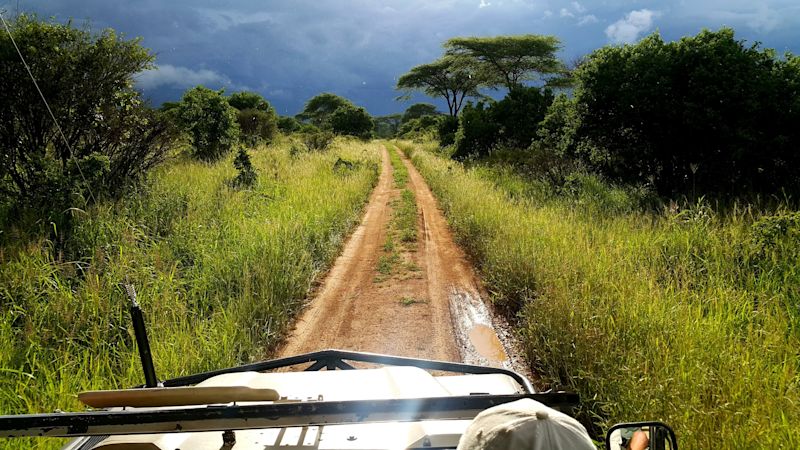
View from a safari vehicle of lush landscape and dirt road on safari in Kenya.
What makes Chyulu Hills different from the Masai Mara or Amboseli
Chyulu Hills offers a different safari experience, unlike Kenya’s more famous parks. It is not about big crowds or dramatic wildlife sightings. Instead, time here slows down, giving you a chance to notice the textures of the soil, the patterns of light, and the movement of wildlife in their natural habitat.
Walking or horseback safaris here allow you to explore the landscape, noticing details you would miss on a standard game drive, such as the patterns of the lava flows, the rustle of birds in the bush, or the curve of a ridge silhouetted against Kilimanjaro on the horizon.
Wildlife is present but often more dispersed than in the Mara or Amboseli. Elephants, giraffes, zebras, buffalo, eland, leopards, and a wide variety of birds move across the hills at their own pace. This slower rhythm lets travellers observe subtle behaviours, from a family of elephants feeding quietly to flocks of colourful birds gathering at hidden springs.
Conservation and community play a central role here. Many of the conservancies are Maasai-owned, supporting both wildlife corridors and local livelihoods. Staying in Chyulu Hills contributes directly to these efforts, from anti-poaching programs to community-led tourism experiences. You might visit a Maasai village, learn about traditional ceremonies, or take part in a conservation activity, adding a more meaningful dimension to the safari.
Seasonal changes bring new experiences. The hills bloom with wildflowers during the rainy season, attracting migratory birds, while dry months reveal dusty plains and make wildlife easier to track. Every season shapes the landscape and the wildlife rhythms differently, offering a fresh perspective on each visit.
Luxury lodges are tucked into remote areas, giving privacy and comfort without detracting from the wilderness feel. Early mornings and late afternoons are perfect for photography, with soft light illuminating ridges and lava flows. At times, the hills feel bigger than the safari itself, with long stretches of silence and uninterrupted views across the plains.
With that said, Chyulu Hills differs from the Masai Mara and Amboseli in several key ways. Unlike the Mara, where wildlife is dense and sightings frequent, or Amboseli, famous for elephants against Kilimanjaro, Chyulu Hills offers a more dispersed, quieter experience. Low visitor numbers give a sense of solitude and connection to both the land and local communities, making the safari more immersive with the locals.
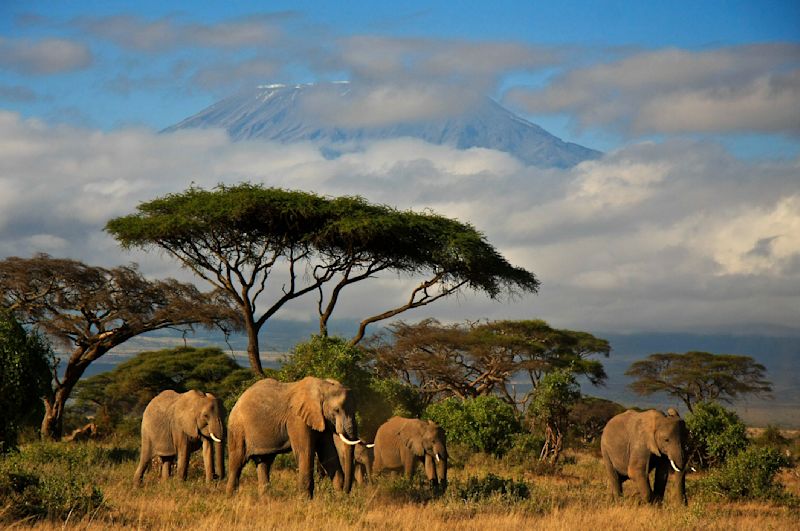
Herd of elephants in Amboseli with Kilimanjaro in the background.
Why the Chyulu Hills are one of Kenya’s most fascinating volcanic landscapes
Chyulu Hills is one of Kenya’s youngest volcanic regions. This is no minor detail; it shapes everything about the landscape. The hills began forming around 1.4 million years ago and, although dormant since the mid-19th century when the Shaitani and Chainu cones last erupted, they still retain a raw, textured character that older mountain ranges have long lost.
The landscape is defined by its volcanic origins. Lava flows and eruptions created ridges, cones, and underground cave systems that remain today. Leviathan Cave, Africa’s longest lava tube, is the most famous of these hidden features, while nutrient-rich soils, porous rock layers, and labyrinthine caves make the region ecologically unique.
The hills themselves do not rise in sharp peaks but roll and fold in green volcanic swells, dotted with black lava fields. Forest and grassland sit on porous rock, while beneath the surface, water filters through underground systems, feeding springs that sustain wildlife and communities alike. Moist ocean air hits the hills, cools, and settles into the soil, emerging in springs such as Tsavo’s Mzima Springs, which produce over 100 million litres of fresh water every day.
It's safe to say that Chyulu Hills is not only a wildlife destination, but it is also a geological one. Its volcanic origins, hidden water networks, and rich soils create a landscape that feels alive, layered, and very different from any other safari region in East Africa.
Lava flows, caves and the hidden geology of Chyulu Hills
One of Chyulu Hills’ most striking features is what lies beneath the surface. The region is shaped by lava flows and volcanic caves, including Leviathan Cave, which is Africa’s longest known lava tube.
It's safe to say this is not just “green safari country”. It is a landscape forged by fire. Millions of years ago, molten lava flowed beneath a cooling crust, leaving tunnels, chambers, and hidden corridors beneath the grasslands and bush. Even if you never enter these caves, they give the hills a sense of mystery and depth that few safari destinations can match.
The geology also supports life. Porous volcanic soils absorb rainfall, feeding underground springs and water systems that sustain wildlife and communities alike. Above ground, the rolling hills and lava fields are dramatic; below, the hidden networks of water and rock are just as vital. Protecting this underground world is a key part of preserving Chyulu Hills as a living, thriving ecosystem.
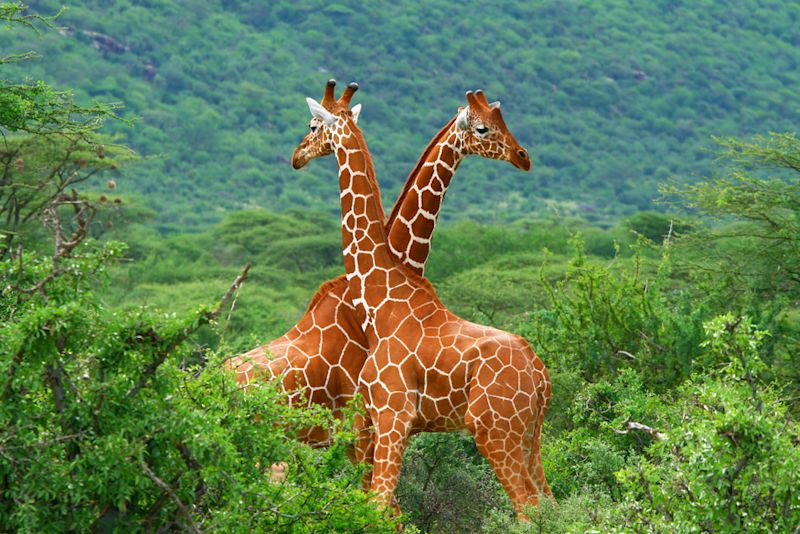
Two reticulated giraffes fighting with their necks during a Kenyan safari.
It’s a question many travellers ask: if Chyulu Hills isn’t about the big wildlife crowds, why are some of Kenya’s most exclusive safari lodges here? The answer lies in space, privacy, and meaningful engagement with the land and local communities rather than the quantity of wildlife sightings.
Luxury here is subtle, grounded, and connected to the landscape. It is not about crowds or spectacle. The best lodges are designed to immerse guests in a living ecosystem, giving access to expansive wilderness and supporting the people who sustain it.
Guests can expect:
Small-scale accommodations: very few rooms or suites, ensuring quiet and privacy.
Low guest density: no traffic jams at watering holes; a personal and intimate safari rhythm.
Private access: lodges often sit on Maasai-owned conservancies or private ranches, including Mbirikani, Olpusare, and Rombo.
Immersive experiences: walking safaris, horseback rides, and guided exploration that allow a deeper connection to the land.
Community and conservation integration: stays contribute directly to local projects, from wildlife protection to education and healthcare.
Campi Ya Kanzi exemplifies this approach. Co-owned and managed by the Maasai community, it spans 280,000 acres at the base of the Chyulu Hills. Visitors here experience untrammelled wilderness, while a portion of the fees supports community programmes, wildlife corridors, and rangeland management. Similarly, ol Donyo Lodge integrates Maasai guides and conservation projects into the safari experience, blending luxury with local insight and responsibility.
Each provides a safari experience that goes beyond game drives as guests witness the landscape’s volcanic ridges, porous soils, and hidden springs, while learning from the people who live alongside the wildlife. The combination of privacy, conservation impact, and cultural connection defines luxury in Chyulu Hills.
Unlike parks where lodges compete to put you in the middle of a constant wildlife spectacle, these camps prioritise immersion, observation, and understanding. Staying here is not simply focused on a safari; it’s a conversation with the land, the wildlife, and the Maasai communities who protect it.
What it actually feels like to stay in Chyulu Hills
Many safari guides miss the point of Chyulu Hills, listing activities without showing what it really feels like to be here. A safari is not about rushing from one sighting to the next; it is about moving through the land and taking it in. Drives through the Chyulus feel exploratory as you cross lava-streaked plains, wind through acacia bush and climb gentle ridges while Kilimanjaro looms on the horizon.
Walking with a Maasai guide is especially rewarding, revealing tracks, birdsong, medicinal plants and the subtle patterns of the landscape that are easy to miss from a vehicle. Horseback rides across open country are another unforgettable way to experience the hills, giving a sense of space and perspective. Evenings bring their own magic, with sundowners on ridgelines, long shadows across the plains and the quiet of private conservancy land. Time seems to stand still here, no distractions, and the luxury lies not in spectacle or excess, but in the atmosphere itself.
Maasai warrior men with one blowing into an antelope's horn.
How Maasai-owned conservancies shape the Chyulu Hills safari experience
To understand the Chyulu Hills, you have to understand the land and who owns it. Much of the ecosystem is made up of Maasai-owned ranches, conservancies, community land and conservation partnerships, alongside protected areas like Chyulu Hills National Park. This is not wilderness preserved by excluding people — it is a living landscape where wildlife, tourism, pastoral livelihoods and conservation all come together.
Elephants and other animals move through Chyulu as part of a larger corridor linking Amboseli and Tsavo, so keeping these routes open is vital for the region’s ecology. Conservancies and community partnerships protect wildlife corridors, grazing systems, habitat connectivity, tourism, and low-impact land use and ensure communities benefit from conservation.
This is also why Chyulu Hills feels so exclusive. Low guest numbers are not just about luxury — they are part of a conservation model. Fewer beds, fewer vehicles and more land per guest make safaris here private, sustainable and genuinely immersive.
Masai warriors on a rocky outcrop with a dining table set up for two.
Conservation in Chyulu Hills
If you are researching Chyulu Hills National Park, the most important story today is not a new lodge or tourism trend. It is the ongoing work to keep this landscape alive and functioning for both wildlife and people.
Chyulu Hills is not a static wilderness; it is an active conservation landscape. Much of the current focus across the broader ecosystem is on keeping habitats connected, reducing human-wildlife conflict, protecting elephant movements, supporting community-led conservation, and maintaining open rangelands. This work is so important in a region where pastoral livelihoods and wildlife share the same land.
That is the real story of Chyulu Hills, not nostalgia or postcard imagery, but a living ecosystem being actively protected. Tourism here helps keep the land open, wildlife mobile, and conservation economically viable. For travellers, that adds a layer of meaning. So if you choose to stay in Chyulu Hills, you will soon realise it is not just about enjoying one of Kenya’s most beautiful safari regions; it is about understanding why places like this still exist.
How to include Chyulu Hills in a Kenya safari itinerary
One common mistake travellers make is judging every safari destination by the same criteria. Chyulu Hills is not designed to replace the Masai Mara; it is designed to complement it. The region works best as part of a balanced Kenya safari.
It pairs especially well with:
Amboseli – The most natural combination. Amboseli offers iconic elephant viewing and open plains, while Chyulu provides exclusivity, privacy and volcanic landscapes.
Masai Mara – The Mara delivers wildlife drama and density, whereas Chyulu provides contrast, quiet and a more intimate safari pace.
Tsavo – For those exploring southern Kenya’s vast ecosystems, Tsavo and Chyulu together create a compelling mix of scale, geology and remoteness.
The Kenyan coast – For a bush-and-beach itinerary, Chyulu works beautifully before heading to the coast, offering a complete change of pace.
The important thing to do is not to rush. Chyulu Hills is not a “tick-box” destination; it rewards time. At minimum, two to three nights are recommended, though more allows you to settle in and fully experience this unique landscape.
Family on a safari enjoying the views of the wilderness in Kenya.
Yes, if you are looking for a different kind of safari. If your goal is to see the largest number of animals in the shortest time, other parts of Kenya may be more suitable. But if you want:
One of Kenya’s most exclusive safari regions;
Fewer vehicles and far more privacy;
Luxury lodges in genuinely wild surroundings;
Walking and horseback safaris;
Dramatic volcanic landscapes;
Meaningful conservation initiatives;
A deeper connection to the Maasai land and the living ecosystems.
If this is what you want, then Chyulu Hills is definitely worth a visit. It may even become the part of Kenya you remember most. Many travellers arrive dreaming of the famous parks, yet leave talking about the quieter, more textured places that linger in memory. That is exactly what Chyulu Hills does best.
It does not overwhelm with spectacle. It stays with you. The green hills Hemingway wrote about are still here; it's remote, strange, beautiful, and offers one of the most refined safari experiences in East Africa. If you want to see a more private and thoughtful side of Kenya, this is where to find it.
Safari with Masai warriors leading camels through green grasslands.
Plan Your Kenya Safari to Chyulu Hills with Follow Alice
For a safari that goes beyond the usual, Chyulu Hills is a landscape worth exploring. Combined with renowned destinations like Amboseli or the Masai Mara, it offers a journey that balances iconic wildlife with quiet, volcanic landscapes. Follow Alice can help you design an itinerary that highlights the best of Chyulu Hills, drawing on our expertise to create a truly informed and immersive experience. Contact our team today, and we will be happy to help.