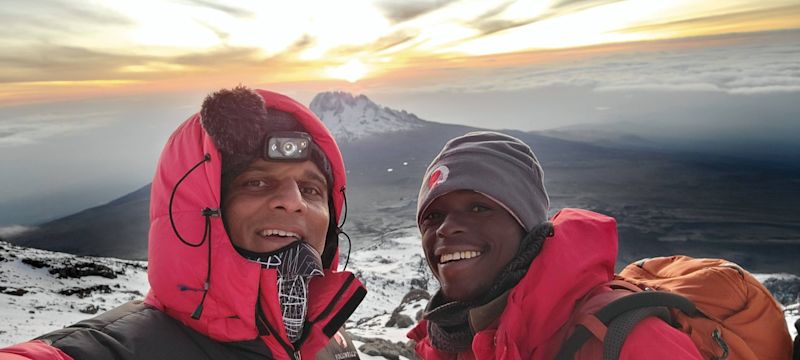
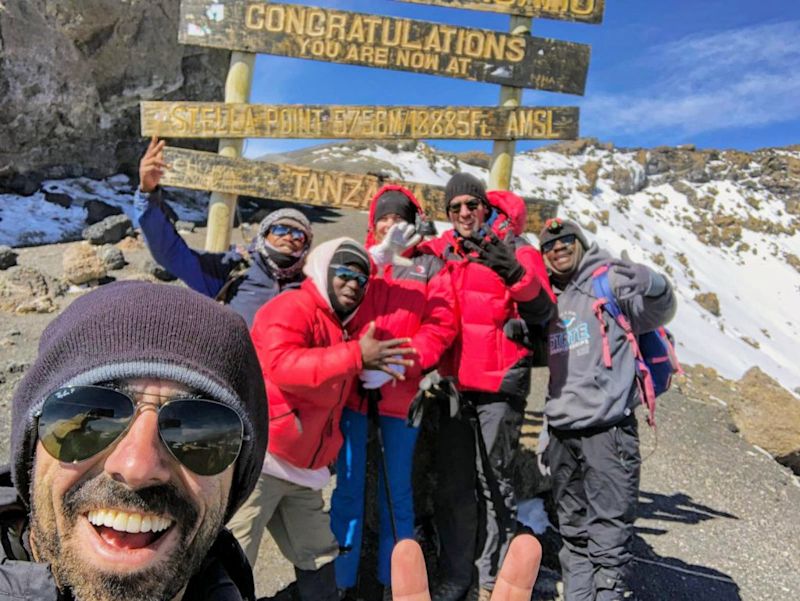
Every year, thousands of solo travellers summit Mount Kilimanjaro. Arriving alone, climbing with a small private crew, or joining a group departure. The mountain doesn't discriminate. What matters is that you're prepared and realistic about the experience.
byTrisha Pillay
Apr 10, 2026
14 min read
Solo trekking to Africa’s highest peak is one of the most rewarding things you can do. It’s normal to question whether you’re capable or not. It's safe to say, though, that you can climb Kilimanjaro solo. Just keep in mind that “solo” here doesn’t mean what it does on most other mountains.
Tanzania National Parks (TANAPA) requires all climbers to be accompanied by a licensed guide at all times. There is no self-guided option on Kilimanjaro. What solo actually means is that you're climbing without a travel companion, but you'll always have a professional guide and, typically, a team of porters by your side. For most people who ask, "Can I climb Kilimanjaro alone?" this is genuinely great news. You get the solitude, the personal challenge, and the mental space of a solo adventure with expert support built in. If you have any questions, feel free to contact us.
Trekker climbing Mount Kilimanjaro.
What does climbing Kilimanjaro solo actually mean?
Solo trekking on Kilimanjaro falls into two very different categories, and understanding the distinction matters before you start planning.
Let's look at the options you can have:
Option 1: Join a group departure as a solo traveller
Many tour operators run scheduled group departures throughout the year. As a solo traveller, you can simply join one of these; this will enable you to share the trail, the campsites, and the camaraderie with a small group of other climbers. This is the most affordable way to climb and an excellent choice if you're open to meeting people. Most solo climbers who go this route are pleasantly surprised by the friendships they form on the way up. Also, check if you can join another solo traveller to cut costs. The one trade-off is that you're on the group's schedule and pace. If you need to slow down for acclimatisation, or you simply prefer to move at your own rhythm, a group departure offers less flexibility.
Trekkers making their way up Kilimanjaro.
Option 2: Book a private solo climb
A private climb means a dedicated guide, assistant guide, and porter team arranged exclusively for you. You set the pace, you choose when to stop and take photographs, and every decision is made around your needs. It costs more, and we mean sometimes significantly more, but it's the closest thing to a truly personal Kilimanjaro experience. This is also the better choice if you have specific acclimatisation concerns, are an experienced hiker wanting to move faster or slower than a group, or simply value the quality of that one-on-one relationship with your guide.
Two trekkers pose for a photo on the Lemosho Route.
How much does it cost to climb Kilimanjaro solo?
One of the most common questions from solo travellers is whether climbing alone means paying more. Honestly, yes, often it does. Here's a realistic breakdown of what to expect:
Option
Approx. Cost (USD)
What's included
Join a group departure
$2,000 – $3,500
Shared crew, shared costs, built-in social element.
Private solo climb (Machame 7-day)
$3,500 – $5,000
Your own guides and porters, flexible pacing.
Private solo climb (Lemosho 8-day)
$4,500 – $6,500
More days, better acclimatisation, premium experience.
Single supplement fee (where applicable)
$200 – $600 extra
Added to group departures for guaranteed private tent.
If you're joining a group departure, some operators charge a single supplement as an extra fee to guarantee you have your own tent rather than sharing. This typically runs between $200 and $600, depending on the operator and route. Always ask upfront whether the single supplement is included or optional. All reputable operators include park fees, rescue fees, crew wages, accommodation, meals, and equipment in the climb price. Be cautious of any quote that seems unusually low; this often means the crew is being underpaid, which affects your safety and the ethics of your climb.
Best Kilimanjaro routes for solo trekkers
Not all routes are equal when you're climbing alone. Some offer more solitude, others are better for acclimatisation, and a few are simply more enjoyable when you have only your own company to rely on. Here's a clean comparison:
Route
Solo rating
Why it works for solo trekkers
Lemosho - 8 days
★★★★★
Most scenic, gradual acclimatisation and the best overall for solo trekkers.
Machame - 7 days
★★★★☆
Popular, sociable trail that is great for solo travellers, open to meeting others.
Rongai - 7 days
★★★★☆
Quieter route, approaches from the north, which is ideal if you value solitude.
Marangu - 6 days
★★★☆☆
Hut-based with communal sleeping, which is the cheapest option but has the lowest success rate.
Shira - 8 days
★★★★☆
Remote start, high acclimatisation and suits experienced solo trekkers.
Northern Circuit - 9-10 days
★★★★★
Longest route, highest success rate and is known for a premium solo experience.
For most solo trekkers, Lemosho (8 days) or the Northern Circuit (9-10 days) offer the best balance of success rate, scenery, and acclimatisation time. The Machame route is a great social option if you're joining a group departure.
Women climb Kilimanjaro solo every single year, and the vast majority describe it as one of the most empowering experiences of their lives. But it's completely understandable to have questions about safety, crew professionalism, and what the experience is actually like on the mountain.
Here's what solo female trekkers consistently say:
Licensed guides and porters operate under strict codes of conduct. Reputable operators vet their crews thoroughly.
You will have your own tent at all campsites, with privacy respected at all times.
Crew members are professional, as many have been guiding for decades and are deeply experienced at supporting climbers of all kinds.
Fellow trekkers on the mountain create an informal community. It's rare to feel isolated.
On a private climb, your guide is entirely dedicated to your well-being and pace.
One Follow Alice trekker shared an amazing review with us on her experience with us:
I just wanted to say thank you for initially talking me into the Kilimanjaro adventure. I’m so happy that I’ve done it, and I really could not have succeeded without the support of the Follow Alice crew. The lead guide Trevor was excellent, from the moment we met him at the Lindrin Lodge briefing. Initially I was slightly disappointed that we were due so much rain and that he suggested we rent ski pants, crampons, ponchos-however I used them all. The sleeping bags were great, and despite not ordering them, we all had fleece liners inside them. I’m not sure if this is always included, but worth mentioning in your literature if so, as other companies charge extra for them. I would not have paid extra for a liner (as I usually hate getting tied up in them) but was very grateful for having it as I was not cold at night.
When choosing an operator as a solo female traveller, ask specifically about crew vetting, female guide availability (some operators now offer this), and what their policy is on client privacy and personal safety. A good operator will welcome these questions without hesitation.
What happens if you get altitude sickness while climbing solo?
This is one of the most important questions solo trekkers ask and one that competitors rarely answer directly. The short answer is you are not alone, and there is a clear plan. Altitude sickness (Acute Mountain Sickness, or AMS) affects a significant number of Kilimanjaro climbers regardless of fitness. Symptoms range from mild headaches and nausea to more serious conditions like High Altitude Pulmonary Oedema (HAPE) or High Altitude Cerebral Oedema (HACE). On a reputable guided climb, here's what happens:
Your guide will monitor you throughout the climb using daily health checks (oxygen saturation, heart rate, symptom assessment).
If symptoms develop, your guide is trained to recognise severity and make the call on whether to slow down, rest, or descend.
Kilimanjaro has a dedicated rescue system. If you need to be evacuated, stretcher teams and medical support are available on the mountain.
Park fees include a rescue levy, which is not optional, and it means evacuation services are funded regardless of your insurance. It is very important, though, to take our travel insurance that covers over 6000m in altitude.
Remember to always carry travel insurance that covers high-altitude trekking and emergency evacuation. This is non-negotiable for Kilimanjaro regardless of whether you climb solo or in a group. Ask your operator whether they carry supplemental oxygen; the best ones do, as a precaution. Solo trekkers on private climbs actually have a slight advantage here, as your guide's sole focus is on you, which means warning signs are less likely to be missed in the way they occasionally can be in larger groups. With that said, trained guides always monitor everyone closely in the group. Here is one of our travellers who shared their opinion on how Follow Alice handles this type of situation.
Our experience with Follow Alice on the 8-Day Lemosho Route was absolutely extraordinary. The guides were world-class—deeply experienced, compassionate, and fully devoted to our safety and success. When one of our teammates developed severe mountain sickness, their team immediately mobilised and descended one of the most difficult routes to get her lifesaving medical care. I will never forget their speed, kindness, and professionalism in that moment. They also brought true “mountain hospitality” to every day—warm tea, surprise treats, and moments of joy in the most breathtaking settings. Daniel, the owner, supported us personally before and throughout the climb, easing every concern with care and presence. Follow Alice also partnered with us in our Kili With Dr. Kelly, Climb With a Cause, to help us raise funds to build a school for children in Tanzania—an alignment of heart and mission that moved us deeply. I would recommend Follow Alice without hesitation to anyone seeking a life-changing expedition.
What it really feels like to solo trek on Kilimanjaro
Most articles about climbing Kilimanjaro solo focus on logistics. Very few tell you what it actually feels like, and if you're reading this, you probably want to know.
Solo trekking is personal in a way that group travel simply isn't. Without a travel companion to distract you, the mountain takes your full attention. Long stretches of the climb, particularly on days six and seven of a Lemosho route, are conducted in near-silence, with only the sound of your own breathing and the crunch of scree underfoot.
There will be moments of profound loneliness. Usually, around day three or four, when the novelty has worn off but the summit is still out of sight. Experienced solo trekkers describe this as the emotional crux of the climb, distinct from the physical challenge of summit night. There will also be moments of extraordinary clarity. The kind that only comes when you strip away distraction and sit with yourself at altitude, watching the sunrise over the clouds at 4,000 metres with no one else in frame.
The guides and porters become more significant companions when you're climbing solo. Many solo trekkers describe forming genuine connections with their crew, learning about their lives, their families, and their own relationship with the mountain they've climbed dozens of times.
Trekker takes a selfie with a Follow Alice crew member.
Just like the physical preparation, it's also important to prepare your mind as well. Let's have a look at ways to improve your mental stamina as well:
Get comfortable with silence before you go. Spend time alone in nature, without podcasts or music.
Set a personal intention for the climb, not just 'reach the summit', but something that gives the experience meaning for you specifically.
Accept that you'll have bad hours. They pass. Experienced solo trekkers don't try to push through the emotional dips; they acknowledge them and keep walking.
Consider journaling on the mountain. Many solo trekkers describe it as one of the most valuable things they brought.
Let's take a look at what one of our trekkers, Beau M, had to say about his experience:
I recently completed a remarkable nine-day journey to the summit of Mount Kilimanjaro, the tallest peak in Africa. The experience was unforgettable, and while the mountain itself is extraordinary, it was our guide, Mr Amedeus, who truly elevated the entire expedition. Our group was fortunate to have a lead guide, Crossman, along with three assistant guides: Amedeus, Gidion, and Rama. Each contributed to our success, but Amedeus stood out as the most memorable. He was not only knowledgeable and professional, but also warm, approachable, and deeply attentive to the needs of every member of the group. From day one, he created an atmosphere of trust and motivation that never wavered. I will never forget the night of our summit push.
Can experienced climbers reduce their crew size?
This comes up regularly from experienced mountaineers who want a more stripped-back experience. The honest answer is to a limited extent, yes, but not as much as you might expect. TANAPA regulations require a minimum of one licensed guide per climber. Beyond that, while there's no formal regulation dictating exactly how many porters you must carry, most reputable operators won't run a private climb with fewer than two guides (a lead guide and an assistant) and at least three to four porters. Kilimanjaro's regulations around maximum porter load weights are strictly enforced by ethical operators. This helps spread gear across more porters, which is a welfare issue. A private solo climb with a skeleton crew is unlikely to meet the standards of a responsible operator. If this matters to you, have the conversation directly with your operator and ask specifically about their crew-to-climber ratios and their rationale.
Porters carry bags up Mount Kilimanjaro.
What do solo climbers do before and after Kilimanjaro?
Kilimanjaro doesn't exist in a vacuum, and for solo travellers, combining the climb with the wider East Africa experience is one of the great joys of the trip. Here's what solo trekkers commonly do:
Before the climb
Arrive in Arusha or Moshi 1-2 days early for acclimatisation and gear check.
Day safari at Arusha National Park or Tarangire for wildlife without a full itinerary commitment.
Cultural visit to a local Chagga community on the mountain's lower slopes.
Elephants walking in Tarangire.
After the climb
Safari in the Serengeti or Ngorongoro Crater, timing a post-Kili safari when your legs have recovered, is a perfect reward.
Zanzibar for beach recovery is the classic combination for good reason: the contrast between summit cold and Zanzibar warmth is extraordinary.
Pemba Island or Mafia Island for diving, if Zanzibar feels too busy.
Many solo travellers find that the independence of solo trekking makes them more adventurous with the broader trip. Without having to negotiate with a companion, you can stay on Zanzibar for exactly as long as you want or leave the next day if you don't feel it.
Beautiful Zanzibar.
Ready to climb Kilimanjaro solo?
Climbing Kilimanjaro solo is one of the most rewarding things you can do. Not because it's reckless or extreme, but because it's personal. The mountain demands something from you that no travel companion can provide. It asks you to show up entirely for yourself.
The regulations mean you'll always have an expert team around you. The logistics, once understood, are straightforward. What remains is simply the question of whether you're ready to spend eight or nine days learning what you're actually made of at 5,895 metres above sea level. Most people who do it say it changes them. Not dramatically or permanently, but in small, important ways. A slightly higher tolerance for difficulty. A clearer sense of what they're capable of. The memory of a sunrise at Stella Point that no photograph fully captures.
If you'd like to talk through your options, private climb versus group departure, route selection, or best time to go, get in touch with our team. We've helped hundreds of solo travellers reach the summit, and we'd love to help you plan yours.
Trekkers pose for a photo after summiting Mount Kilimanjaro.
Plan your solo Kilimanjaro climb
Speak to one of our Kilimanjaro specialists about routes, timing, and exactly what solo trekking looks like in practice. We offer both private climbs and group departures with guaranteed single-tent accommodation.