Exploring Bhutan's Forests: What First-Time Visitors Need to Know About Its Unique Ecosystems
May 20, 2026
Bhutan has a forest cover of 72 per cent, with more than half the country falling under protected areas, but what does that actually mean when you are walking through it? Here's what first-time visitors need to know about the ecosystems and the wildlife.
byTrisha Pillay
May 20, 2026
9 min read
At Follow Alice, this is one of the things we love most about Bhutan: while many countries talk about conservation, the Land of the Thunder Dragon wrote it into its constitution.
At least 60 per cent of Bhutan's land must remain under forest cover permanently, by law. The current figure sits at around 72 per cent. The country absorbs more carbon than it emits, making it one of the few carbon-negative nations in the world. These are not tourism slogans; they are policy decisions that shape the experience of travelling there. You notice it quickly because the air feels cleaner, the forests remain largely intact, and many trails are noticeably quieter than those in more heavily developed mountain destinations in the Himalayas.
But understanding Bhutan's forests is not just about appreciating the statistics. It's about knowing what you're actually walking through because Bhutan consists of six distinct ecological zones in a single vertical rise, and most visitors pass through at least three of them on a standard itinerary without realising it.
Why Bhutan's forests are different from anywhere else in the Himalayas
Bhutan shares a mountain range with Nepal and northern India, but the comparison ends there. Across much of South Asia, forest cover has been fragmented by agriculture, logging, and development. Wildlife populations have been isolated into shrinking pockets. In Bhutan, the opposite has happened.
All ten of Bhutan's protected areas, covering nearly 20,000 square kilometres, roughly the size of Switzerland, are connected by a network of biological corridors. This isn't just good conservation planning on paper. It means animals move freely between habitats, maintaining genetic diversity and allowing species to follow seasonal ranges that would be impossible elsewhere. Tigers are documented at over 4,000 metres of elevation. Snow leopards descend into the conifer forest in winter. Elephants are moving north from the Duars into the mid-hills. None of this happens by accident, but it happens because the corridor system allows it. This tiny nation sits at the heart of the Eastern Himalayas, one of the ten most biodiverse regions on earth. Its vast forests also play an important role in absorbing carbon dioxide and limiting the impact of climate change.
The Gross National Happiness Framework (GNH) is Bhutan's alternative to GDP-led development, placing ecological preservation at the centre of national policy. Low industrialisation and a small population (under 800,000) mean that pressure on forest land has stayed manageable. The result is a country where the wildlife hasn't been pushed to the edges. It still occupies the full range of its natural habitat.
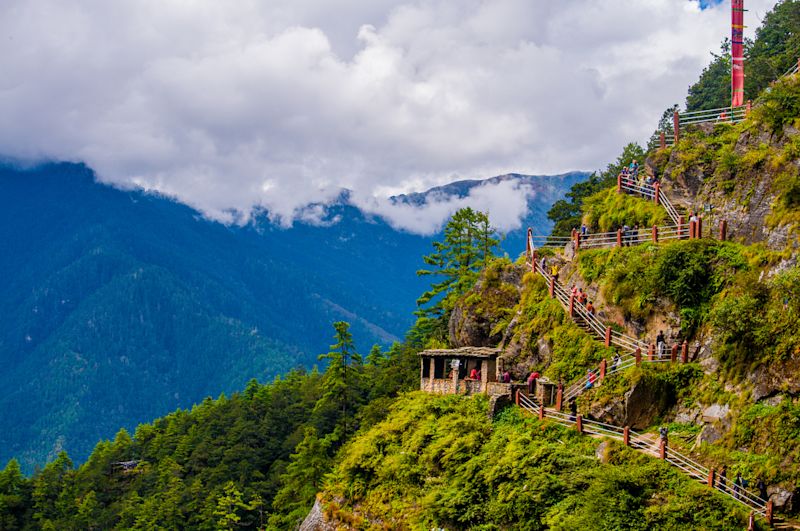
Hiking path to the famous Paro Taktsang or Tiger's Nest monastery, Bhutan.
From subtropical forests in the south to high alpine landscapes near the Tibetan border, Bhutan’s terrain changes dramatically across relatively short distances. These shifts in altitude and climate create six distinct ecological zones, each with its own wildlife, vegetation and trekking experience.
Let’s take a look.
1. Wet Subtropical Zone (150–600m): Royal Manas and the Southern Duars
The southern edge of Bhutan sits at around 150 metres above sea level, in the Duars plain, a belt of dense subtropical broadleaf forest, tall grassland, and riverine habitat running along the Indian border. This is where the biodiversity concentration is highest and, for many species, most dramatic.
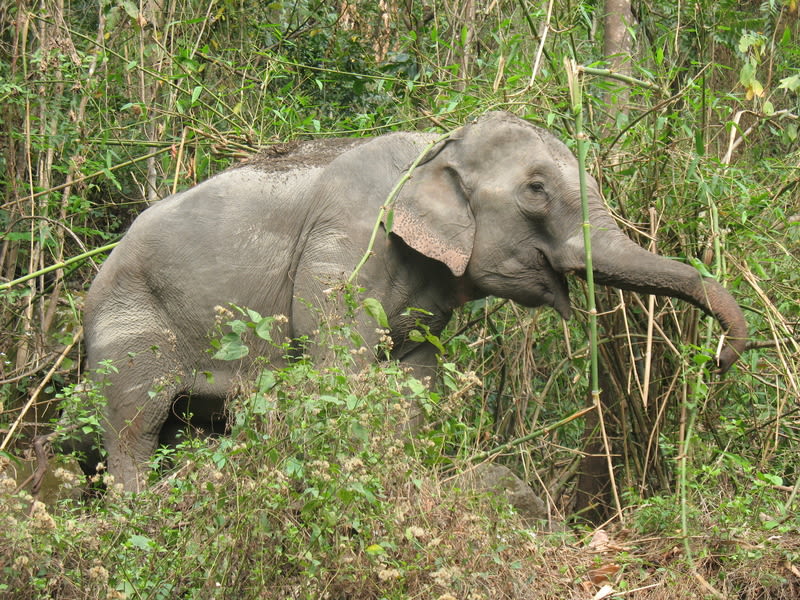
Royal Manas National Park anchors this zone. It protects Bengal tigers, Indian one-horned rhinos, Asian elephants, golden langurs (a primate found almost nowhere else on earth), clouded leopards, and more than 360 recorded bird species. It is one of the most biodiverse areas in the entire Himalayan region. Walking here means humidity, dense canopy, and the kind of layered birdcall that fills the forest from the ground up. This is not the Bhutan of mountain panoramas and dzong fortresses, but it's wilder, louder, and hotter. Access requires a specialist wildlife permit and is best approached with an operator who can provide dedicated local guides.
2. Humid Subtropical Zone (600–1,200m): The transitional forest belt
As elevation rises, the tall grasslands and riverine forest of the Duars give way to a denser broadleaf canopy, which is still warm and humid but noticeably different in character. This transitional zone is ecologically rich precisely because it sits between two distinct habitats: species from the subtropical lowlands move up into it seasonally, and species from the temperate forests above range down into it. Most visitors pass through this zone on the road north from Phuentsholing without registering the shift.
3. Dry Subtropical Zone (1,200–1,800m): Valleys, settlement, and Chir Pine
This is the zone where much of Bhutan's human settlement is concentrated, the lower river valleys, agricultural terraces, and roadside towns that form the connective tissue between the wilder zones above and below. The vegetation shifts noticeably here as chir pine appears, the forest opens out, and the landscape takes on a drier, more open character than either the humid subtropical zone below or the temperate forests above.
It's easy to underestimate this zone ecologically because it's also where the infrastructure is. But the biological corridors connecting Bhutan's protected areas pass through it, and the movement of wildlife between north and south depends on this belt remaining open. That it largely does is one of the less-celebrated aspects of Bhutan's conservation record.
4. Warm Temperate Zone (1,800–2,600m): Rhododendron forest and red pandas
The warm temperate zone is where the character of Bhutan's forests becomes unmistakable. Oak, chestnut, maple, and magnolia dominate the canopy, and rhododendron. Bhutan has over 50 species that fill the understorey and the ridgelines. In spring, from March through May, the flowering transforms entire hillsides: walls of red, pink, and white at altitude, visible from the trail before you're close enough to hear anything.
This is the zone that most visitors to Bhutan spend the most time in. The Paro and Thimphu valleys sit within it. The Tiger's Nest trail climbs through it. The red panda lives here, alongside Himalayan black bears, barking deer, and common leopards. The forest floor is dense and damp, and on overcast days when cloud drops into the canopy, the trail experience is among the most atmospheric in Asia.
5. Cool Temperate Zone (2,600–3,600m): Conifer forest and snow leopard territory
Above the rhododendron belt, the broadleaf species thin out and fir, blue pine, and hemlock take over. The forest becomes quieter. Light reaches the ground more easily. This is snow leopard country, the zone they descend into in winter, following blue sheep down from the high ground above. Blue sheep themselves are frequently visible on rocky slopes at the upper edge of this zone, often in groups large enough to spot from a distance without binoculars.
Treks into Jigme Dorji National Park, which is Bhutan's largest protected area, covering over 4,300 square kilometres of western and central highland, pass through this zone on their way to the alpine terrain above. The park holds one of the highest-density snow leopard populations in the country.
6. Alpine Zone (3,600–4,600m): High wilderness and tigers at altitude
Above the treeline, dwarf juniper, alpine grasses, and bare rock take over entirely. The Wangchuck Centennial National Park occupies a vast sweep of this high-altitude terrain in north-central Bhutan, bordering Tibet. It is remote, rarely visited on a standard itinerary, and home to some of the most remarkable large mammal populations in the country.
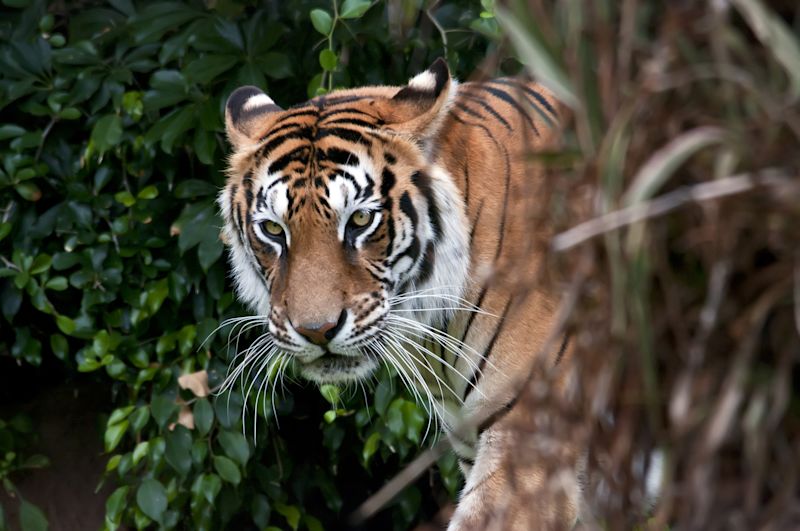
The documented presence of Bengal tigers at over 4,000 metres elevation in this zone is one of the most significant conservation discoveries of recent years. It is only possible because Bhutan's biological corridor system has kept the population large and genetically viable enough to range this far, with tigers moving freely between the subtropical south and the alpine north through intact habitat. No other country in the world can make that claim.
The Bengal tiger is seen roaming around in Bhutan.
Here is what most first-time visitors to Bhutan will actually encounter in the forests: birdsong, clean air, rhododendron canopy, the occasional barking deer at dusk, and, if they are trekking at altitude, blue sheep on a ridge. The forests feel alive and intact in a way that is immediately noticeable to anyone who has trekked in Nepal or northern India. But tiger sightings are rare. Snow leopards are extremely rare. The animals are present; they are simply not waiting at the trailside.
This is worth stating plainly because a visitor who goes in expecting a wildlife safari will miss what Bhutan's forests are actually offering. The experience here is ecological immersion of walking through landscapes that haven't been degraded, breathing air that hasn't been compromised, and moving through an ecosystem that still functions as it should. That is genuinely uncommon, and for most visitors, it is more affecting than any single wildlife encounter could be.
For those who want dedicated wildlife encounters like camera traps for snow leopards in Jigme Dorji, bird surveys at Royal Manas, tiger tracking in the south, those programmes exist, and they deliver. But they require time, the right season, and a guide with specialist knowledge.
Asian elephant in Manas Royal National Park in Bhutan.
Wildlife disturbance in forest ecosystems is almost entirely a function of noise and pace. Large commercial groups move fast and talk loudly; animals hear them before they get close. Follow Alice runs small-group treks that move slowly enough to watch, stop frequently, and allow for the kind of naturalist-led interpretation that transforms a forest walk from physical exercise into genuine education.
In the rhododendron zone, that means pausing to identify which species is flowering above you. In the conifer belt, it means knowing where to look for snow leopard pugmarks in the snow. In the high alpine, it means understanding what you're looking at when you see blue sheep scattering on a ridge 400 metres away. The forest experience in Bhutan is quieter and more immersive in a small group, where there is more space for patience and attention. Bhutan's forests are the mechanism behind everything that the country's conservation reputation is built on. Walking through them properly, slowly, with someone who can explain what you're seeing, is one of the more rewarding things you can do in the Himalayas. If you still have questions, feel free to contact our team.