Small-Group Kilimanjaro for Beginners: What to Expect in 2026
May 14, 2026
If you are planning a Kilimanjaro climb, understanding how a guided small-group expedition actually works can make all the difference. Before booking or packing, it helps to know what the daily rhythm, safety and pacing look like in practice.
byTrisha Pillay
May 14, 2026
11 min read
If you have decided to climb Mount Kilimanjaro and are now trying to understand how a guided group climb actually works, this article is for you. Not the booking details or the gear list, but what comes before all of that: what a small-group Kilimanjaro climb looks like from the inside, how pacing and safety are managed, what happens each day on the mountain, and why it matters for first-time climbers.
The term “small group” appears on almost every Kilimanjaro operator’s website, but very few explain what it actually means. If you still have questions, feel free to contact our team. We are always happy to help and answer any queries. As a small-group adventure travel operator, we focus on personalised support and attention throughout your journey.
Trekkers ready to tackle the mountain.
What “small group” actually means on Kilimanjaro
The industry uses the term loosely. Some operators describe groups of 16 or more as small. Others cap at 12, and a handful go lower. The number matters more than the label, so it is worth asking any operator you research to state their group size cap plainly before you read anything else about them.
At Follow Alice, groups typically run between 6 and 10 climbers and never exceed 12. That ceiling is not marketing language. It is the number at which a lead guide can meaningfully observe every person in the group every day, notice who is moving differently on day five than they were on day two, and make individual pacing decisions based on what they see.
In a group of 40, that level of attention is not possible. In a group of 12 with multiple assistant guides on the team, it is.
The crew-to-climber ratio reflects this, too. A group of four Follow Alice climbers, for example, travels with a mountain crew of around 21 people: a lead guide, assistant guides, porters, helper porters, and a cook. A group of 12 requires a crew of around 57. These are not small numbers, and they reflect something the industry sometimes obscures: a Kilimanjaro climb is not a hike with a guide. It is a full mountain expedition, and the crew behind you is what makes it safe. They are often described as the unsung heroes of the mountain.
Some of the Follow Alice team members are ready to take on Mount Kilimanjaro.
Acclimatisation is the process by which your body adjusts to reduced oxygen at altitude. Above 3,000 metres, the effects of altitude begin to be felt. At Kilimanjaro’s summit of 5,895 metres, the air contains roughly half the oxygen available at sea level. How your body handles that ascent is the single biggest determinant of whether you reach the summit.
The Kilimanjaro industry average for summit success is roughly 65-85 per cent across all routes and operators. Follow Alice’s recommended route for first-time climbers is the eight-day Lemosho or the Northern Circuit, which has one of the highest summit success rates of any route on the mountain. The reason in both cases is the same: more time on the mountain, more deliberate altitude management, and a pace that can only be properly maintained in a small group.
The eight-day Lemosho starts at Lemosho Gate at 2,100 metres, well below the altitude at which serious symptoms develop. It ascends slowly through five ecological zones before a deliberate "climb high, sleep low" day on Day 5, where climbers ascend to Lava Tower at 4,630 metres and then descend to Barranco Camp at 3,967 metres for the night. That dip of over 600 metres in a single day is one of the most physiologically significant things that happens during the entire climb. The body responds to the higher altitude exposure and then recovers at the lower sleeping elevation, building tolerance without the strain of holding altitude overnight too soon.
The Northern Circuit takes this logic further. After the shared opening days with the Lemosho, the route loops around the quieter northern face of the mountain, with Day 5 dropping to Pofu Camp at 4,033 metres, lower than the previous night, and Day 6 dropping further still to Third Cave at 3,870 metres. Two consecutive nights of descending elevation in the middle of the climb are unusual among Kilimanjaro routes and are a direct reason why the Northern Circuit carries the highest summit success rate of all seven routes on the mountain. Climbers arrive at the summit base camp having spent more time around the 4,000 metre mark than on any other itinerary, with a body that has had repeated opportunities to adjust to the altitude before the final push.
What a guided Kilimanjaro package actually includes
First-time climbers often reach out to operators without a clear picture of what a guided package covers day to day. The answer varies between operators, and asking for specifics before booking is strongly worth doing.
A Follow Alice guided Kilimanjaro package includes airport transfers, pre- and post-climb accommodation in Moshi or Arusha, all meals on the mountain, tents, sleeping bags, a private toilet tent, park fees, crew wages, and the full mountain crew for the duration of the climb. Please note that tipping is completely separate. The good thing is that there are no middlemen. Follow Alice sells and runs its own climbs, which means the people who plan your trip are the same people responsible for how it is executed on the mountain. You can have a look at all our packages when you click here.
Trekkers eating in the mess tent on their Kilimanjaro climb.
Each day on the mountain follows a rhythm that most climbers adjust to quickly. The crew wakes climbers with hot drinks in the morning, a warm hand into the tent before you have to face the cold air. Breakfast is cooked and served in a mess tent. After hiking, the crew moves ahead to set up camp before you arrive. You reach the campsite and find your tent already pitched, your sleeping bag already inside.
Lunch is eaten at the trailside. Dinner is cooked and hot. In the evening, the lead guide briefs the group on the following day: the altitude, the distance, what to wear, and what to expect. The oxygen readings from the evening health check are discussed openly. Questions are answered, and then you rest.
This is the schedule for most of the climb, and it is more comfortable than many first-time climbers expect. The mountain crew’s experience means that logistics, including water, food, tent placement, and equipment, are handled completely. Your job is to walk, eat, drink, and sleep.
Trekkers concentrating on climbing Mount Kilimanjaro.
Summit night is different in almost every way from the days before it. You arrive at Barafu Camp, the base camp for the summit attempt, in the afternoon of your final day of ascent. You eat an early dinner, prepare your summit pack, and go to bed around 7 pm. You are woken at 11 pm by your mountain crew, given a hot drink, and begin climbing at midnight.
The reasons for the midnight start are practical. The timing places your arrival at Uhuru Peak around sunrise, which means you benefit from the best visibility and the most emotionally powerful moment the mountain offers. The frozen scree that covers the upper slopes is also more stable in the cold of the night than in the warmth of the day.
The climb from Barafu to the summit covers around 1,300 metres of vertical gain over approximately five to seven hours. It is cold, dark, steep, and slow. The pace is dictated entirely by the guide, and in a small group, that pace is set with the slowest comfortable member of the group in mind, not the fastest. No one is left behind, and no trekker is expected to push through alone.
At Stella Point on the crater rim at 5,739 metres, climbers get their first view of the summit and often their first view of sunrise across the African plains. From there, it is roughly 45 minutes to Uhuru Peak.
The descent follows the same day: down to Barafu for lunch, then continuing down to Mweka Camp for the final night. Descending quickly to a lower altitude after summiting is deliberate. The air at base camp is still thin; dropping further allows the body to recover more effectively overnight before the final walk out the following morning.
A thin line of trekkers was seen walking up to the summit.
The quality of your lead guide is the most important variable in a Kilimanjaro climb. What does “experienced guide” actually mean in practice?
Chris Sichalwe, director of Follow Alice Tanzania, has been climbing Kilimanjaro since 1999 and has over 300 successful summits. He did not begin as a director but as a porter. That progression from the base of the mountain’s crew structure upwards through assistant guide and lead guide to operator is the kind of mountain knowledge that cannot be manufactured. It comes from having done every role the mountain requires, in every weather condition and season, across more than two decades.
The guides who lead Follow Alice climbs are trained in daily altitude health assessments, know the mountain’s weather patterns across seasons, and carry emergency oxygen on every expedition with a clear evacuation plan for every climb.
When researching any Kilimanjaro operator, ask specifically: How many summits has the lead guide completed? What first-aid or wilderness medicine qualifications does the guide hold? What is the evacuation protocol if a climber needs to descend urgently? A trustworthy operator will answer all three questions without hesitation.
Follow Alice holds KPAP (Kilimanjaro Porters Assistance Project) certification and earned a perfect score from the organisation that independently monitors porter welfare across the mountain. KPAP member companies are subject to unannounced checks. Choosing a KPAP-certified operator means that the welfare of the crew behind your climb is independently verified, not self-reported.
Chris Sichalwe, director of Follow Alice Tanzania.
Why a local operator with Kilimanjaro roots matters for first-time climbers
There is a category of Kilimanjaro operator that sells climbs without operating them: international travel agencies that contract with local companies on the ground, taking a margin and providing a polished booking experience while having limited visibility into what happens on the mountain itself.
The alternative is an operator that is both seller and operator. This is a company whose leadership climbs the mountain themselves, whose guides work with the same company year after year, and whose reputation lives and dies on what actually happens between Lemosho Gate and Uhuru Peak.
This distinction matters most to first-time climbers, who have no prior experience to draw on when something goes wrong or feels uncertain on the mountain. When the guide who briefed you before departure is the guide standing next to you at 4,600 metres asking how you are breathing, the reassurance is qualitatively different from what any pre-departure customer service team can offer.
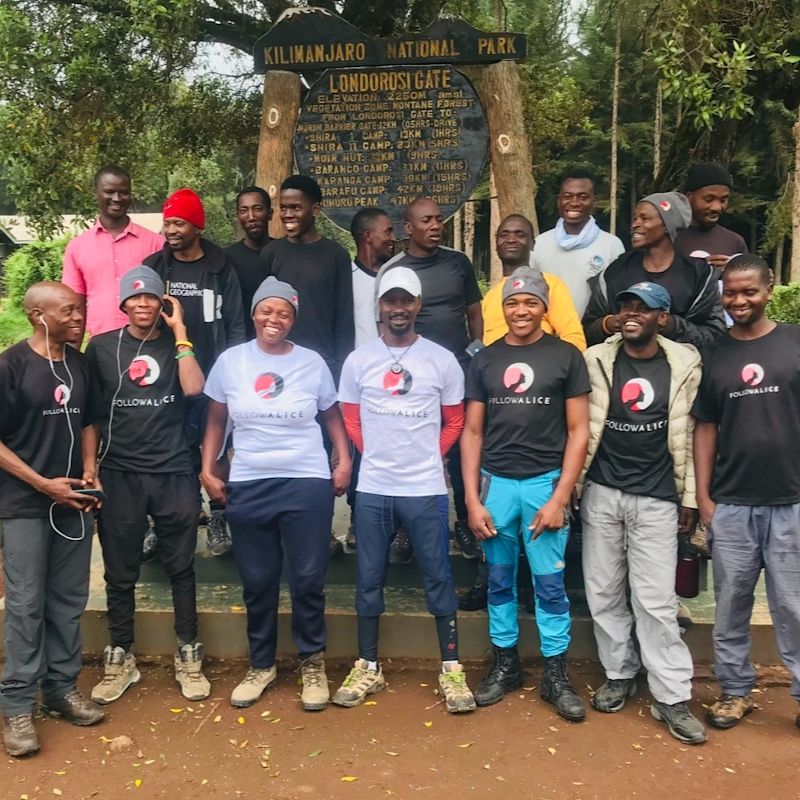
The Follow Alice crew pose for a picture at the start of the Mount Kilimanjaro trek.
Follow Alice runs small-group and private Kilimanjaro climbs throughout the year on all main routes, with the eight-day Lemosho as the standard recommendation for first-time climbers. Groups run between 6 and 10 climbers and are capped at 12. All climbs are guided by an experienced local team with deep mountain knowledge, daily altitude health monitoring, and a full support crew certified by KPAP. If you are ready to start planning, or have questions this article has not answered, get in touch with the Follow Alice team. We would rather you ask everything now than arrive on the mountain with uncertainties you have been carrying since booking.