Does Kilimanjaro Tourism Actually Benefit Local Communities?
Apr 30, 2026
Kilimanjaro tourism has grown significantly, supporting jobs and livelihoods across Tanzania. But fair pay and where that income goes depend on the operator you choose. Here’s what the data shows, what can go wrong, and how to make a positive impact.
byTrisha Pillay
Apr 30, 2026
11 min read
There's a version of the Kilimanjaro story that goes like this: a beautiful mountain, a booming local economy, and thousands of visitors every year contributing to the livelihoods of Tanzanian families. This story isn't wrong, exactly, but it leaves out quite a lot.
While Kilimanjaro tourism generates about USD 50 million a year and supports thousands of Tanzanians, fair pay and real local impact still depend on your operator. The reality is that Kilimanjaro tourism can be very beneficial to local communities, or it can quietly exploit the most vulnerable people on the mountain, and the difference between those two outcomes comes down almost entirely to which operator a climber books with. If you care about where your money goes, and you're reading this, we're guessing you do, then understanding that difference is one of the most important things you can do before you book. If you have any questions, please feel free to contact our team.
Kilimanjaro tourism impact on local communities
Every climber on Kilimanjaro requires a crew. A typical eight-day expedition involves a lead guide, assistant guides, a cook, and a team of porters. That's a lot of people whose livelihoods depend on the mountain, and on the visitors who come to climb it.
Kilimanjaro brings in roughly USD 50 million in tourism revenue each year. That money flows through hotels, transport companies, gear suppliers, guides, cooks, and porters. A 2025 study examining communities around Kilimanjaro National Park found that the economic benefits of tourism are unevenly distributed, with relatively little reaching the areas of greatest poverty. The jobs exist, the money exists, but the question is what happens to it on the way down.
What the research makes clear is that the impact of Kilimanjaro tourism on local communities is not fixed. It varies significantly depending on how operators structure their businesses, whether they pay fair wages, source food locally, invest in their staff, and funnel money back into Tanzanian supply chains rather than out of them.
Follow Alice Kilimanjaro crew readying food and supplies.
Kilimanjaro porter wages
The clearest way to see the gap between ethical and unethical operators is to look at porter wages, because the data is specific and the difference is large. The Kilimanjaro Porter Assistance Project (KPAP) is the main organisation dedicated to improving conditions for mountain porters. They track wages across the industry, and what they've found is alarming. Porters working for non-KPAP-affiliated operators earn on average Tsh 25,860 per day, while those with KPAP partner operators earn around Tsh 36,074 per day. This means KPAP-affiliated operators pay their porters roughly 40 per cent more than non-affiliated ones. It isn't explained by market forces or economic complexity. It's explained by one thing, and that is which company the climber booked with.
According to KPAP, operators should pay fair daily wages to crew members, including at least 20,000 Tsh for porters, 30,000 Tsh for cooks and assistant guides, and 40,000 Tsh for guides. Salaries should be paid within two days after a climb, and a transparent tipping system should be in place to ensure porters receive their full share. However, pay varies widely across the industry. Around 70 per cent of Kilimanjaro operators do not meet KPAP's ethical labour standards. Which means the majority of climbers on the mountain, right now, are unknowingly supporting a system that underpays the people carrying their gear up to nearly 6,000 metres above sea level.
At Follow Alice, we believe a successful summit is only possible thanks to the crew who support you on the mountain. As proud KPAP members, we encourage all climbers to do their research before booking a Kilimanjaro climb. Also, you need to remember that budget operators keep prices low by cutting porter wages. This isn’t a cynical interpretation, as it simply reflects how the economics of the industry work. Climbers generally can't see what porters are being paid when they're comparing two itineraries online, and still the undercutting continues.
Porters on the open path in the alpine desert of the Marangu route on Kilimanjaro.
Kilimanjaro ethical tourism
"Ethical tourism" is a phrase that gets used a lot on Kilimanjaro, including by operators who don't back it up with verifiable practice. That's worth saying plainly. A company can describe itself as responsible, community-focused, or environmentally conscious without any of that language being tied to anything auditable. It's one of the more frustrating factors of the industry, because it makes it very difficult for well-intentioned climbers to know who to trust.
This is why KPAP's partnership programme matters, as partner operators don't just sign up to a set of principles. They are audited, they commit to minimum daily wages for porters, proper cold-weather gear provision, maximum load limits, adequate food and shelter for crew, and ongoing monitoring. If they fall short, they lose the partnership. This kind of accountability is uncommon, which is precisely why it's worth looking for.
Trekkers and porters on their way up Mount Kilimanjaro.
Kilimanjaro responsible tourism
Responsible tourism on Kilimanjaro shows up in specific, practical ways. Here are the things worth asking about before you book.
Porter wages and load limits
A reputable operator should be able to tell you what their porters are paid and what load limits they enforce. KPAP sets a maximum recommended load of 20 kg. Many non-compliant operators exceed this routinely.
Gear provision
Porters working at altitude need proper cold-weather clothing. In budget operations, inadequate gear is common. This is not a comfort issue at elevation. It's a health and safety issue.
Local supply chains
Where does the food come from? Operators who source from local suppliers keep money circulating in the Tanzanian economy. Operators who don't, don't.
Tanzanian staff in senior roles
An operator genuinely invested in the community employs local guides in leadership positions and provides pathways for staff to grow within the business. At Follow Alice, Chris Sichalwe started as a porter on Kilimanjaro in 1999 and is today the Director of Follow Alice Tanzania. This kind of progression is what genuine investment in people looks like.
KPAP partnership status is the clearest single indicator of whether an operator has made verifiable commitments to porter welfare, and it is both easy to check and important.
Watch Chris’s story about what life was like when he worked as a porter:
Kilimanjaro porter welfare
Porters are the invisible workforce of Kilimanjaro, yet they are the true heroes of the mountain. Climbers can spend a week on the mountain without fully appreciating what the people carrying their tents, food, and equipment are experiencing.
On operations that don't meet ethical standards, porters commonly carry loads above the recommended maximum, sleep in conditions significantly worse than those of the clients they support, receive inadequate food at altitude, and lack proper cold-weather gear. These are documented patterns, not edge cases.
The physical demands of portering are considerable. Porters move faster and more frequently than guided clients, often without adequate time to acclimatise. They do this in conditions that demand proper gear, proper nutrition, and fair pay. Without those things, the personal achievement of reaching the summit comes at someone else's expense.
KPAP partner operators address this directly. When you climb with a KPAP partner, your crew's wages are audited, their gear is provided, their loads are limited, and they work within a system that treats them with dignity. The result is also a better climb for you: guides and porters who feel respected bring a different quality of care to their work, and climbers notice it.
One of our clients, Dr Kelly Martin Schuh, described it this way after her Follow Alice expedition: when a member of her group developed severe altitude sickness, the team mobilised immediately and descended one of the most difficult routes to get her to medical care. "I will never forget their speed, kindness, and professionalism in that moment," she wrote. That kind of response doesn't come from a team that has been treated as a line item.
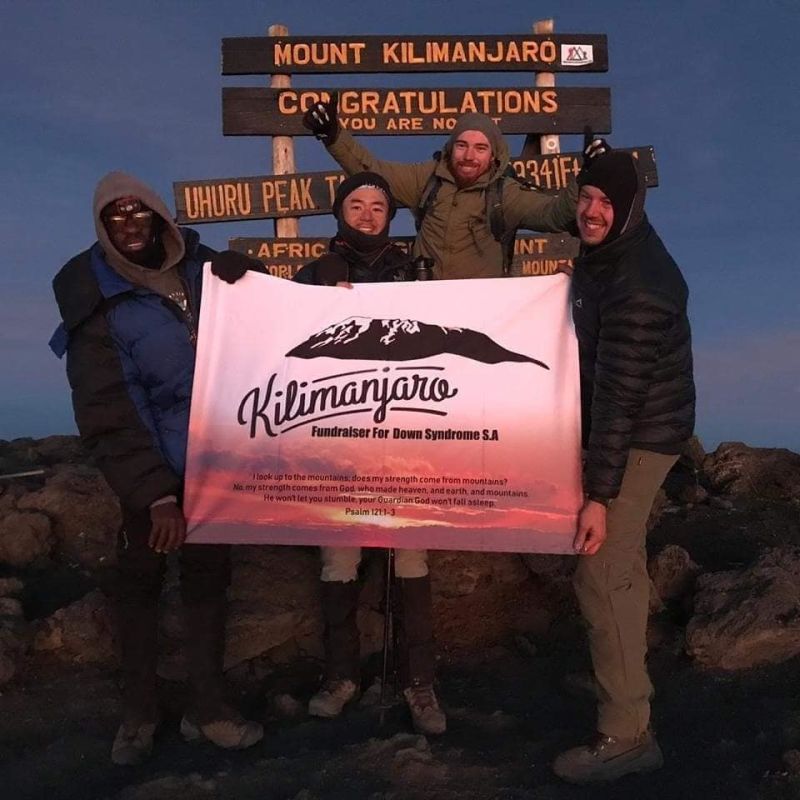
Dewald and Francois with Down Syndrome SA at Uhuru Peak with guides.
The impact of a well-run Kilimanjaro operation doesn't end at the mountain gate. Operators who are genuinely committed to community benefit make choices about where they source food and equipment, who they develop into leadership roles, and how they invest in the regions where they operate.
Some climbers go further, using the mountain as a platform for direct community contribution. One of our clients, Dewald, and his friend Francois, climbed with Follow Alice in February 2019 to raise R200,000 (around USD 14,000) for Down Syndrome South Africa. Whereas Dr Kelly's expedition supported a campaign to build a school for Tanzanian children, a goal Follow Alice partnered in wholeheartedly. We have other climbers who are helping with dental care, all in an effort to empower the local communities in the area. For us here at Follow Alice, these aren't incidental extras. They reflect an approach to adventure travel where the people and places you visit matter as much as the destination itself.
We think there are four honest questions every responsible tour operator should be able to answer:
Do our services offer local entrepreneurs growth opportunities?
Does our business benefit the local economy?
Do we help protect the wildlife and the environment we visit?
Do we hold ourselves accountable to those commitments in a way that can be verified?
We definitely hold ourselves accountable to these four, and if an operator can't answer those questions clearly, that's worth noting.
The origins of Follow Alice are directly linked to the treatment of porters on Kilimanjaro. Before organisations like KPAP existed, conditions for many porters were poor, with low wages, inadequate gear, and no accountability. The founding of Follow Alice was shaped by a conviction that this was wrong, and that a better way of doing things was both possible and necessary. As well as empowering local communities, who would provide a better experience than someone who does not know their surroundings well enough.
That conviction runs through everything we do today. Our guides are trained to the highest certification level and renew their safety qualifications annually. Our porters receive proper cold-weather gear, fair wages, and are supported by a crew structure that values their experience and well-being. We are a KPAP partner, which means those commitments are not self-reported. They are audited.
We also take the environmental side of responsible tourism seriously. Every client who books a Kilimanjaro climb with us receives a preparation document that includes Kilimanjaro National Park's leave-no-trace policy in full, covering waste management, equipment choices, and everything in between. The mountain is extraordinary, and we want to keep it that way.
Follow Alice porter's receive first aid training.
Kilimanjaro community benefit
The question of whether Kilimanjaro tourism benefits local communities doesn't have one answer. It has an operator-by-operator answer. Around 70 per cent of operators on the mountain don't meet ethical labour standards. Porters working for those operators earn 40 per cent less than those working with KPAP partners. The economic benefits of tourism are unevenly distributed. These things are true regardless of how many operators describe their trips as community-focused or responsible.
What a conscientious climber can do is book with an operator who has made verifiable commitments: to porter wages, gear, load limits, local supply chains, and community investment. The difference between operators is real, and it shows up in the daily lives of the people who make your climb possible.
Kilimanjaro is absolutely worth climbing. Climbing it in a way that genuinely benefits the mountain and the people around it is worth the small amount of extra research it takes to get it right. We'd be glad to be part of that climb with you, and if you're looking to find out more, feel free to book a call with our team.