Luxury Everest Base Camp Trek vs Classic Trek: What’s the Difference?
Apr 9, 2026
Are you thinking about trekking to Everest Base Camp but not sure if a classic or luxury trek is right for you? Many travellers know they want to go, but are unsure which option will suit them best.
byTrisha Pillay
Apr 9, 2026
11 min read
The Follow Alice Classic EBC Trek is a 14-day fully guided adventure through the Khumbu Valley packed with legendary trails, teahouse lodges, and the raw, immersive experience of trekking to base camp and back on foot. While the Follow Alice Luxury EBC Trek with helicopter transfers is a 10-day premium journey that pairs the same iconic Himalayan landscapes with private helicopter flights, hand-picked mountain lodges, and all meals included, giving you the lush experience without the exhaustion.
Both trips are guided by Follow Alice's expert local team, rated 5 stars across every review ever left. In this article, we break down exactly what makes each trek different, so you can choose which best suits your needs. If you are still unsure, feel free to contact our team with any questions.
A suspension bridge on the EBC trek in Nepal.
Luxury Everest Base Camp Trek vs Classic Trek
You've decided you want to trek to Everest Base Camp. Smart choice. Now comes the question that surprises most people, and that is, there isn't just one way to do it.
If you browse trekking itineraries for long enough, you'll find the classic EBC trek sitting alongside something called a luxury Everest trek, and this often comes with a very different price tag and a helicopter somewhere in the description. What exactly are you paying for? And which one is right for you?
We'll compare both options across every dimension, focusing on the duration, comfort, accommodation, altitude experience, physical demand, and cost, so you can make the right call before you book.
Quick comparison: Classic vs Luxury EBC Trek
Here's a quick breakdown:
Classic EBC Trek
Luxury EBC Trek
Duration
14 days
10 days
Trekking days
11 days on foot
7 days on foot
Price from
USD 1,790 per person
USD 8,990 per person
Helicopter transfers
No, you will only get a connecting local flight to Kathmandu–Lukla.
Yes, from Kathmandu to Lukla, Gorakshep to Lukla, Lukla to Kathmandu.
On paper, the difference between the treks might seem like just four days. But on the trail, that small gap translates into a very different experience as you might have more time to acclimatise, explore villages, and soak in the mountains. One cuts out some trekking days, the other is an easier option. Let’s take a closer look at what each trek truly offers.
The Classic EBC Trek (14 Days)
The Follow Alice Classic EBC Trek follows the legendary Lukla-to-Everest Base Camp route the way it was meant to be walked, which is entirely on foot, over 11 trekking days, through every village and valley that makes this one of the world's great walks.
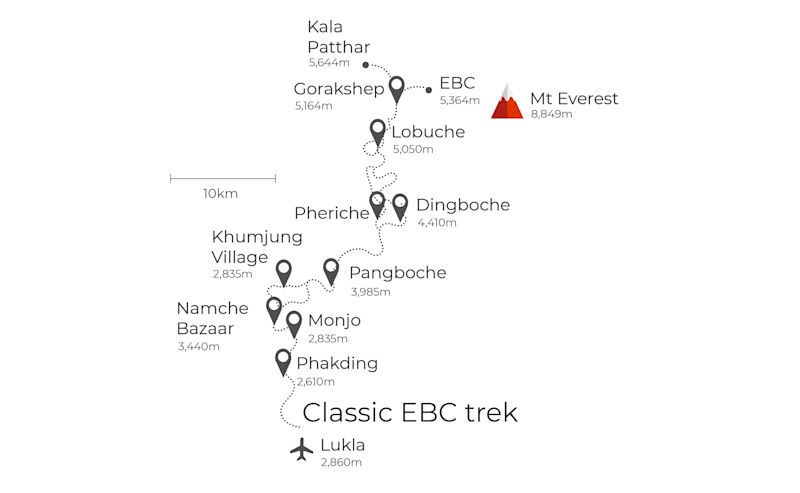
You fly from Ramechhap to Lukla on Day 2 and begin the trek immediately, passing through Phakding, Namche Bazaar, Tengboche, Pangboche, and Dingboche, with a proper acclimatisation day before pushing higher. You reach Everest Base Camp on Day 8, summit Kala Patthar at dawn on Day 9, and then take a quieter, off-the-beaten-path return route through Khumjung Village, a Follow Alice touch that most operators skip. The trek finishes back in Lukla on Day 12, with a flight to Kathmandu on Day 13. The cumulative distance is around 130 km round-trip. It is a genuine trek, and that is entirely the point.
Here is the map of the Classic EBC Trek.
The Luxury EBC Trek (10 Days)
The Follow Alice Luxury EBC Trek with helicopter transfers covers the same iconic Khumbu Valley but in a completely different way. You arrive at Gokarna Forest Resort, a property set in a private forest outside Kathmandu, and on Day 2, you fly by private helicopter directly to Lukla, bypassing both the overland transfer to Ramechhap and the notoriously delay-prone mountain flight.
From Lukla, you trek on foot for 7 days, passing through Namche Bazaar (with a proper acclimatisation hike to the famous Everest View Hotel), Tengboche Monastery, Dingboche, and Lobuche, reaching Gorakshep and optionally Everest Base Camp or Kala Patthar on Day 8. There is no long walk back. On Day 9, a private helicopter lifts you from near base camp to Lukla, and on Day 10, a final helicopter completes the journey back to Kathmandu. The trek ends as it began: at Gokarna Forest Resort, where a spa awaits. The helicopter return doesn't cut the adventure short; it just changes where the adventure ends. Instead of four days of backtracking, your last memory of the Khumbu is from the air.
A group of trekkers enjoying their helicopter route.
What changes when you do the EBC Luxury Trek
This is where the two treks diverge most noticeably in day-to-day experience. On the Classic Trek, accommodation is in traditional teahouse lodges, basic but perfectly functional, and very much part of the authentic EBC experience. You share the trail with other trekkers, eat at communal dining tables, and sleep in simple rooms. It is not glamorous, but there is a warmth and community to it that many trekkers fall in love with this experience.
On the Luxury Trek, Follow Alice has hand-picked the best lodges on the route. In Lukla, Namche Bazaar, and Tengboche, you stay at Yeti Mountain Home, a name synonymous with premium trekking accommodation in the Khumbu. In Debuche/Tengboche, there is the option of Rivendell Lodge. Above Namche, every lodge has been selected for private bathroom access where the route allows.
Meals are another major distinction. On the Classic Trek, food is purchased on the trail and not included in your trip price. On the Luxury Trek, all meals during the trek are included, which is breakfast, lunch, and dinner, removing both the daily cost uncertainty and the decision fatigue that comes at the end of a long trekking day.
In Kathmandu, the Classic EBC Trek places you in a hotel in the busy Thamel district. The Luxury EBC Trek bookends your journey at Gokarna Forest Resort, which is a retreat-style property with spa facilities, offering a genuinely restorative start and end to the experience.
A typical meal that you will be served during a trek in Nepal.
Altitude, acclimatisation, and physical demand
Both treks reach the same altitude. Everest Base Camp sits at 5,364 m, and Kala Patthar, which is the high point of both itineraries, stands at 5,644 m. Neither option shortcuts the altitude. You have to earn it either way. What differs is the recovery experience between high days. On the Classic Trek, you are trekking for six to nine hours most days at an elevation with basic accommodation to rest in. After eight or nine consecutive days at altitude, with a full return journey still ahead, fatigue accumulates. This is not a problem for well-prepared, fit trekkers; it is the experience they signed up for, but it is worth being honest about.
On the EBC Luxury Trek, the itinerary builds in more breathing space. The acclimatisation day in Namche (Day 4) is spent on a gentle hike to the Everest View Hotel rather than pushing directly upward. Lodges with private bathrooms and better insulation make a meaningful difference to sleep quality at altitude. And crucially, the helicopter return on Day 9 means your body doesn't have to descend 65 km on foot after already spending 7 days above 3,400 m. This matters most for travellers who are newer to high-altitude trekking, have limited time to recover mid-trip or simply want their energy concentrated on the ascent rather than the return.
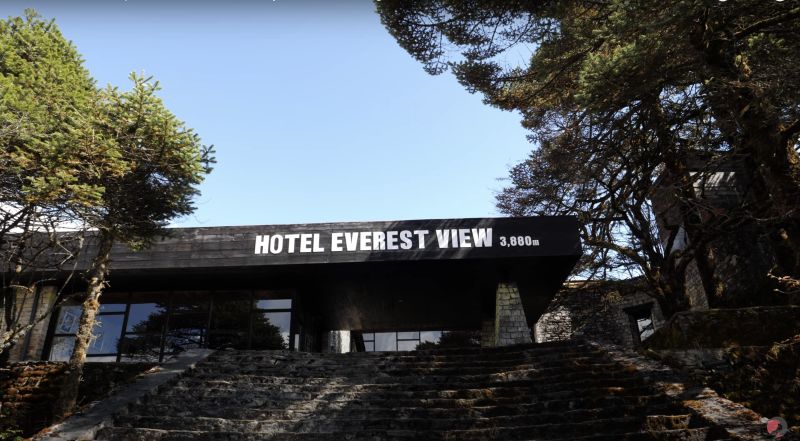
View upstairs to the entrance of Hotel Everest View, EBC trek in Nepal.
Is the helicopter return actually worth it?
This is the question most travellers are really asking, and the honest answer is that it depends on what you want the trek to be.
The helicopter return on the EBC Luxury Trek does several things at once. It eliminates four days of descending on tired legs, allows you to arrive in Kathmandu relaxed rather than exhausted, and provides an aerial perspective of the Khumbu glaciers and peaks that no ground-level experience can replicate. For many trekkers, the moment of lifting off from near base camp, watching the Himalayas drop away beneath the helicopter, becomes one of the defining memories of the entire trip. The descent by foot is beautiful. But if you've already stood at base camp, sometimes the best way to close that chapter is to fly.
The helicopter return is most worth it if you are short on annual leave and cannot afford 14 days; if you want to maximise energy for the ascent rather than saving reserves for the walk back; if luxury accommodation and meals are important to how you travel; or if this is your first high-altitude trek and you want more comfort built in.
The Classic Trek is the better choice if you want every metre of the EBC trail under your boots, including the quieter return route through Khumjung Village that Follow Alice adds to the standard itinerary; if cost is a primary factor, or if the experience of a multi-week trek is as important to you as the destination itself.
The Follow Alice Classic EBC Trek starts from USD 1,790 per person. The Luxury EBC Trek with helicopter transfers starts from USD 8,990 per person. This is a substantial difference, but it's worth understanding what accounts for it.
What's included
Classic Trek
Luxury Trek
Helicopter transfers (×3)
No
Yes (KTM–Lukla, Gorakshep–Lukla, Lukla–KTM)
All meals on trek
No
Yes
Accommodation quality
Standard teahouse lodges
Yeti Mountain Home / Rivendell Lodge
Kathmandu hotel
Thamel district hotel
Gokarna Forest Resort
Permits and taxes
Included
Included
Guide and porter
Included
Included
Starting price
USD 1,790 per person
USD 8,990 per person
Private helicopter charters in Nepal are expensive, and a single round trip to the Khumbu region typically costs several thousand dollars. Premium lodges in the Khumbu command premium rates precisely because of their location and limited supply. And Gokarna Forest Resort is genuinely a world-class property. The luxury price reflects real, tangible upgrades and not padding.
Follow Alice team in Nepal posing in front of the helicopter.
Choosing between the classic Everest Base Camp trek and a luxury option affects more than just comfort. The pace, daily distances, and style of accommodation all shape the way you experience the mountains and the journey to base camp. If you are still confused after reading this article, let us help you break it down.
Choose the Classic EBC Trek if...
You want the full, traditional Everest Base Camp experience with every step, every suspension bridge and every village.
You have 14 days available and want to use all of them walking.
Budget is a primary consideration.
You're an experienced trekker who finds the rhythm of a long walk deeply satisfying.
You want a unique return route through Khumjung Village, which most operators don't include.
Trekkers are enjoying the hike up the EBC Trek.
Choose the Luxury EBC Trek if...
You have 10 days and want to make every one of them count.
Comfortable accommodation and good sleep at altitude matter to you.
You want a helicopter perspective on the Himalayas as part of the journey.
This is your first high-altitude trek, and you'd like more comfort built in.
You're celebrating something, an anniversary, a milestone birthday and want the experience to feel premium from start to finish.
You want all meals and transfers handled, with nothing to think about except the trek itself.
View of the helicopter taking flight on the EBC Trek.
Whichever option you choose, both treks offer the same expert guidance, care, and support, leaving you free to focus on the adventure and make memories that last a lifetime. If you're ready to take the next step, then explore the Follow Alice Classic EBC Trek or the Luxury EBC Trek with Helicopter Transfers and book a call with the Follow Alice team if you'd like help choosing. Both trips run with the same 5-star guides, the same commitment to responsible travel, and the same guarantee that your only jobs are to train and pack.